

TLDR:
- Place volunteer experience strategically: integrate with work experience (for career changers, recent graduates, or filling employment gaps), create a dedicated section after work experience (for experienced professionals with supplementary volunteering), or mention in summary (for board-level roles)
- Quantify achievements using people impacted, money raised or saved, time efficiency, growth metrics, scope of responsibility, or frequency (e.g., “Coordinated 4 community events serving 200+ attendees, increasing participation by 35%”)
- Include only relevant volunteer work: leadership positions, sustained involvement (3+ months), roles demonstrating transferable skills, or experience filling employment gaps; exclude one-time events and irrelevant activities
- Optimize for ATS by using standard section headers (“Volunteer Experience” or “Community Involvement”), incorporating keywords from job descriptions naturally, using consistent date formatting, and labeling positions clearly with “(Volunteer)” or “Volunteer [Title]”
Volunteer work isn’t just about giving back, it’s a powerful way to demonstrate skills, fill employment gaps, and show commitment to causes that matter. Yet many job seekers either leave volunteering off their resumes entirely or bury it in a way that recruiters miss.
The truth? When positioned strategically, volunteer experience can be just as valuable as paid work experience. It showcases transferable skills, leadership abilities, and initiative which are the qualities every employer values.
Why Volunteer Experience Matters on Your Resume
Recruiters spend an average of 7 seconds scanning each resume. During that brief window, volunteer experience can differentiate you from other candidates, if it’s presented correctly.
Volunteer work demonstrates:
According to Deloitte’s 2016 Impact Survey, 82% of hiring managers prefer candidates with volunteer experience, yet volunteer experience appears on only 30% of resumes, making it an underutilized differentiator.
When volunteer experience becomes critical:
The key isn’t whether to include volunteering on your resume; it’s how to position it so Applicant Tracking Systems and recruiters immediately recognize its value.
Where to Place Volunteer Experience on Your Resume
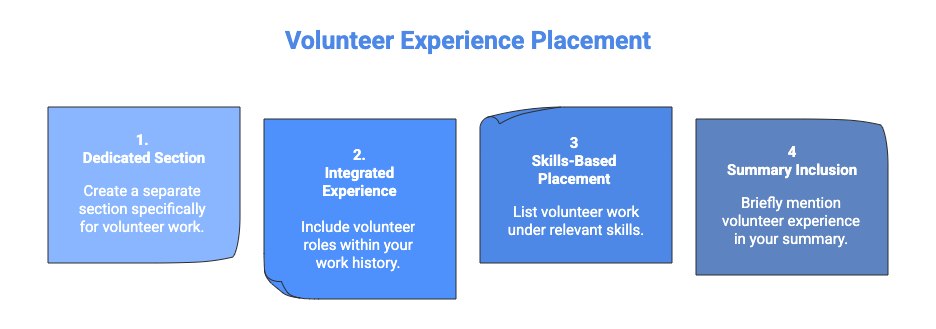
Placement depends on your resume format and how volunteer work fits with other resume sections.
Option 1: Dedicated “Volunteer Experience” Section
Best for: Professionals with substantial paid work experience who want to highlight community involvement separately.
Place this section after your work experience section but before education. This approach works when volunteering supplements, rather than replaces, your professional background.
Example structure:
Copied!Work Experience [Paid positions listed here] Volunteer Experience [Volunteer roles listed here] Education
Option 2: Integrated Within Work Experience Section
Best for: Career changers, recent graduates, or when volunteer work directly relates to your target role.
List volunteer positions in reverse chronological order alongside paid roles in a unified “Work Experience” or “Relevant Experience” section. This approach gives volunteer work equal weight and prevents resume gaps.
Label each entry clearly: include “(Volunteer)” or “Volunteer [Title]” after the position name.
Option 3: Skills-Based Placement
Best for: Highlighting specific skills gained through volunteering when those skills directly match job requirements.
Reference volunteer experience within your skills section, then provide details in a separate volunteer section. This dual approach ensures ATS systems catch relevant keywords while giving recruiters context.
Option 4: Within Summary or Profile
Best for: Senior professionals where volunteering demonstrates leadership or board-level experience.
Mention significant volunteer roles (board positions, advisory roles) in your professional summary, then detail them in a dedicated section.
Placement decision framework:
| Your Situation | Recommended Placement |
|---|---|
| 10+ years paid experience, volunteering is supplementary | Dedicated section after work experience |
| Recent graduate or <3 years experience | Integrated with work experience |
| Career changer with relevant volunteer experience | Integrated with work experience |
| Employment gap filled by volunteering | Integrated with work experience |
| Board member or advisory roles | Summary + dedicated section |
| Volunteer work unrelated to target role | Brief mention or omit entirely |
How to Write Volunteer Experience: The Formula

The same principles that make paid work experience compelling apply to volunteer roles: focus on achievements, quantify impact, and demonstrate transferable skills.
The Basic Format
Position Title (Volunteer) | Organization Name | Location Dates (Month/Year – Month/Year)
The Achievement-Focused Approach
Weak volunteer descriptions read like job duties. Strong ones showcase impact.
Before (duty-focused):
After (achievement-focused):
Action Verbs That Demonstrate Leadership Skills
Start each bullet point with strong action verbs that convey initiative and impact:
Leadership & Management: Directed, coordinated, led, managed, supervised, mentored, trained, delegated
Communication: Presented, authored, negotiated, facilitated, collaborated, advocated, promoted
Problem-Solving: Streamlined, resolved, improved, optimized, redesigned, implemented, innovated
Results-Oriented: Achieved, increased, reduced, generated, exceeded, delivered, launched
How to Quantify Volunteer Achievements
Numbers make accomplishments concrete. Even if you don’t have precise metrics, estimate conservatively.
Quantification strategies:
When exact numbers aren’t available, use ranges (“50-75 participants”) or conservative estimates (“100+ attendees”).
Resume Examples with Volunteer Experience
Example 1: Recent Graduate (Integrated Format)
RELEVANT EXPERIENCE
Marketing Coordinator (Volunteer)
Local Food Bank | Chicago, IL | March 2025 – Present
- Developed social media content strategy that increased Instagram engagement by 125% and grew follower base from 800 to 2,400 in 6 months
- Designed email campaigns for 3,000+ subscribers, achieving 28% open rate (12% above nonprofit industry average)
- Coordinated volunteer recruitment campaign that attracted 45 new volunteers, filling 90% of scheduling gaps
Marketing Intern
ABC Marketing Agency | Chicago, IL | June 2024 – August 2024
- Assisted with social media management for 5 client accounts, creating 40+ posts monthly
- Conducted competitor analysis research that informed 3 client campaign strategies
Why this works: The volunteer role is listed first because it’s more recent and demonstrates greater responsibility than the internship. The “(Volunteer)” label is clear but doesn’t diminish the position’s importance.
Example 2: Career Changer (Integrated Format)
PROFESSIONAL EXPERIENCE
Project Manager (Volunteer)
Habitat for Humanity | Austin, TX | January 2025 – Present
- Manage construction timelines and coordinate 15-20 volunteers per build day across 3 concurrent home projects
- Reduced material waste by 30% through improved inventory tracking system and vendor relationship management
- Train and mentor new volunteer team leads on safety protocols, project management tools, and quality standards
High School Teacher
Austin Independent School District | Austin, TX | May 2025 – September 2025
- Managed classroom of 30+ students while coordinating with 8 department colleagues on curriculum development
- Led cross-functional team of 4 teachers to redesign science curriculum, improving student assessment scores by 18%
Why this works: For someone transitioning from teaching to project management, the volunteer role demonstrates directly relevant experience. Integrated placement shows continuous professional development and fills the recent timeline gap.
Example 3: Experienced Professional (Dedicated Section)
WORK EXPERIENCE
Senior Financial Analyst
Tech Corp | San Francisco, CA | February 2025 – Present
- Lead quarterly financial forecasting process for $50M business unit, improving accuracy by 15%
- Manage team of 3 junior analysts and oversee monthly reporting to executive leadership
VOLUNTEER EXPERIENCE
Treasurer (Board Member)
Youth Arts Foundation | San Francisco, CA | May 2025 – October 2025
- Oversee $400,000 annual budget and present quarterly financial reports to 12-member board of directors
- Implemented new accounting system that reduced month-end close time by 40% and improved reporting accuracy
- Provide financial guidance for strategic planning initiatives and grant application processes
Why this works: The dedicated section highlights board-level leadership without competing with paid experience. The volunteer role demonstrates skills beyond the day job (board governance, nonprofit finance) while reinforcing core competencies.
Want to see complete resumes with volunteer experience in context? Explore our 20 ATS resume examples across different industries and career stages.
Common Mistakes to Avoid
Mistake 1: Listing Duties Instead of Achievements
❌ Don’t write:
“Volunteered at animal shelter helping with daily tasks”
✅ Do write:
“Coordinated adoption events that placed 30+ animals in permanent homes over 6-month period”
Mistake 2: Being Vague About Dates or Commitment
Gaps in dates or unclear timelines raise red flags. Be specific about your volunteer tenure, even if it was short-term.
❌ Don’t write:
“Volunteer, Red Cross
✅ Do write:
“Disaster Relief Volunteer, American Red Cross | March 2025 – August 2025”
Mistake 3: Including Irrelevant Volunteer Work
Not all volunteer experience belongs on your resume. A one-time 5K run participation doesn’t demonstrate professional skills. Focus on sustained involvement where you contributed meaningfully.
Include when:
Omit when:
Mistake 4: Underselling Your Impact
Volunteer work often involves significant responsibility. Don’t diminish it with weak language.
❌ Original
“Helped with fundraising activities”
✅ Improved for industry resume
“Co-led annual fundraising campaign that generated $75,000, exceeding goal by 25%”
Mistake 5: Poor Formatting That Confuses ATS
Applicant Tracking Systems need clear structure to parse your resume correctly. Use standard section headers and consistent formatting.
ATS-friendly practices:
Optimizing Volunteer Experience for Applicant Tracking Systems
A huge number of resumes get filtered out by ATS before reaching human recruiters. Your volunteer experience needs to pass these systems first.
Keyword Integration Strategy
Review the job description for your target role and identify required skills. Then mirror that language in your volunteer experience descriptions.
Example job description requirement: “Experience with project management and cross-functional team coordination”
Your volunteer bullet point: “Managed cross-functional volunteer team of 12 members to coordinate quarterly community outreach events, completing all projects on time and within budget”
The ATS will recognize “project management,” “cross-functional team,” and “coordinate”, increasing your match score.
Resume Format Considerations
ATS-friendly formatting for volunteer sections:
Make Your Volunteer Work ATS-Friendly
Before submitting applications, check how ATS systems will read your volunteer experience. AI-powered resume optimization platforms like Upplai can show you exactly which keywords you’re missing and how well your volunteer experience aligns with specific job descriptions.
This real-time feedback helps you understand whether your volunteer experience is positioned to get past ATS filters, which is something manual resume review can’t reveal.
Resume Tips for Volunteers: Quick Checklist
Use this checklist before submitting your resume to ensure volunteer experience is working in your favor:
Placement & Structure:
Content Quality:
ATS Optimization:
Strategic Decisions: