
TLDR:
- A resume summary is a 3-4 sentence statement highlighting your most relevant qualifications, experience, and measurable achievements for a specific role
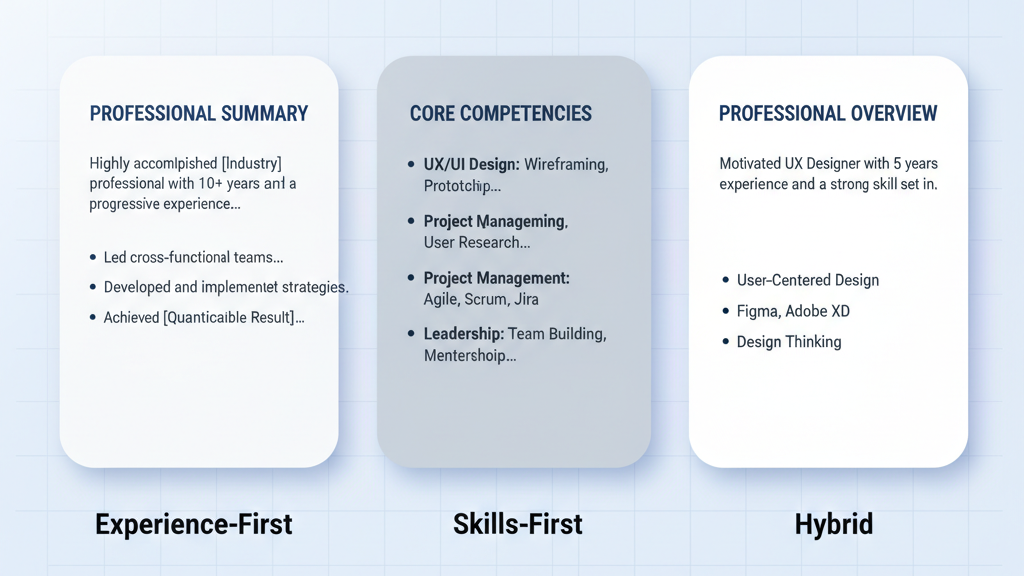
- Use proven formulas based on your career level: Experience-First (for 10+ years), Skills-First (for career changers or recent grads), or Hybrid (for executives with diverse expertise)
- Tailor for each application by analyzing the job description, identifying 3-5 priority requirements, and incorporating those exact keywords naturally into achievement statements
- Include quantifiable results instead of generic claims: replace “improved efficiency” with “cut processing time by 30%” and “managed team” with “led 12-person remote team across 3 continents”
- Avoid common mistakes: using clichés without context, writing in first person, exceeding 4 sentences, listing responsibilities instead of achievements, or using the same summary for every application
Your resume summary is the first thing recruiters see, and often the last if it doesn’t immediately demonstrate your value. In the 5-7 seconds recruiters spend scanning your resume, your summary needs to convince them you’re worth a closer look.
In this guide, you’ll learn:
Let’s cut through the noise and focus on what actually works.
What Is a Resume Summary?
A resume summary is a 3-4 sentence statement at the top of your resume that highlights your most relevant qualifications, experience, and value proposition for a specific role. Think of it as your elevator pitch in written form. It needs to immediately answer the recruiter’s question: “Why should I keep reading?”
What a resume summary is NOT:
The best resume summaries are specific, quantifiable, and tailored to the job description. They demonstrate measurable achievements and include keywords that align with the target role- critical for getting past ATS filters.
Why Your Resume Summary Matters More Than You Think
Here’s the reality: 99% of Fortune 500 companies use Applicant Tracking Systems to filter applications. Your resume summary plays a dual role—it needs to satisfy both the ATS algorithm looking for specific keywords and the human recruiter looking for relevant experience.
The ATS challenge: These systems scan your resume for keywords from the job description, rank them by importance, and calculate a match score. If your summary doesn’t include high-priority keywords naturally integrated into your experience, your resume may never reach a recruiter.
The human challenge: Even if you pass the ATS, recruiters spend an average of 5-7 seconds on initial resume screening. Your summary needs to immediately communicate that you’re a strong match for the role.
A well-crafted resume summary does both. It incorporates job description keywords while telling a compelling story about your professional qualifications and career trajectory.
How to Write an Effective Summary
There’s both art and science behind writing a resume summary that grabs attention and communicates your value in seconds.
The science is about structure- following proven formulas that make hiring managers (and applicant tracking systems) take notice. The art is about you- expressing what makes your story stand out.
Here’s how to craft a resume summary that’s concise, tailored, and genuinely memorable:
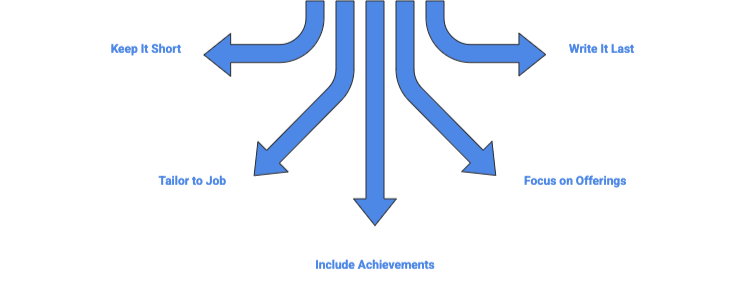
1. Keep It Short (3–4 Sentences)
Your resume summary isn’t meant to narrate your entire career story. Think of it as your highlight reel, not the full documentary.
Stick to three or four crisp sentences that spotlight your most relevant skills, experiences, and results. Every word should earn its place. Focus on impact and clarity. Hiring managers often skim summaries first, so make yours instantly meaningful.
2. Tailor It to the Specific Job and Industry
Generic summaries are easy to write, and even easier to forget. A customized summary, however, shows that you understand what matters most to this role and this employer.
Mirror key phrases from the job description (without copy-pasting) and weave in language that’s familiar to the industry. This not only helps you pass ATS filters but also signals that you’ve done your homework. Tailoring shows intent- and intent stands out.
3. Include Measurable Achievements
Numbers speak louder than adjectives. Whenever possible, quantify your success to show real-world impact.
Instead of saying you “improved efficiency,” say you “cut processing time by 30%.” Replace “responsible for managing a team” with “led a 12-person remote marketing team across 3 continents.”
Metrics give your achievements credibility and make your contributions easier to visualize.
4. Focus on What You Offer- Not What You Want
A resume summary isn’t about your career goals; it’s about the value you bring.
Hiring managers are making a business decision, not granting a wish. Show how your skills solve their problems. For example:
- ❌ “Seeking a role where I can expand my knowledge of project management.”
- ✅ “Project manager with a track record of delivering complex projects on time and under budget, ready to streamline operations at Company XYZ.”
Note the shift in focus- from self to service. It transforms your summary into a powerful pitch.
5. Write It Last
Your best summary comes after you’ve written the rest of your resume. Once all the sections are filled out, you’ll have a clear view of your top achievements and themes.
Think of it like writing a movie trailer after the film is done. You know the best scenes to feature. Writing it last helps ensure your summary feels cohesive, intentional, and perfectly aligned with the rest of your resume.
Pro tip:
If you’re just starting your career, a resume objective may be a better fit than a summary. It lets you highlight your goals and enthusiasm while showing employers what you aim to contribute. Learn how to write one here.
The 3 Core Resume Summary Formulas That Work
Formula 1: The Experience-First Summary
Best for: Mid to senior-level professionals with 10+ years of experience
Structure:
[Years of experience] + [Job title/industry] + [2-3 key skills] + [Notable achievement with metrics]
Example:
Copied!Senior Marketing Director with 12+ years driving growth for B2B SaaS companies. Expert in demand generation, account-based marketing, and marketing automation platforms (HubSpot, Marketo). Led campaigns that generated $15M in pipeline and increased MQL-to-SQL conversion by 34% year-over-year.
Why it works: This formula immediately establishes credibility through experience while incorporating specific keywords (demand generation, account-based marketing, HubSpot, Marketo) that ATS systems prioritize. The quantifiable achievement provides concrete evidence of impact.
Formula 2: The Skills-First Summary
Best for: Career changers, recent graduates, or professionals with non-linear career paths
Structure: [Professional identity] + [3-4 relevant skills] + [How you apply these skills] + [Measurable outcome or certification]
Example:
Copied!Data Analyst specializing in Python, SQL, Tableau, and predictive modeling. Translate complex datasets into actionable business insights that drive strategic decision-making. Reduced customer churn by 18% through cohort analysis and retention modeling. Google Data Analytics Professional Certificate holder.
Why it works: When you don’t have extensive years of experience in a specific role, leading with relevant skills demonstrates capability. The certification adds credibility, while the measurable outcome proves you can apply these skills effectively.
Formula 3: The Hybrid Summary
Best for: Executives, specialists, or professionals with diverse expertise
Structure: [Job title] + [Years of experience] + [Specialization/niche] + [Key achievement] + [Unique value proposition]
Example:
Copied!Chief Financial Officer with 15+ years leading financial strategy for high-growth technology companies through IPO and M&A transactions. Orchestrated $200M Series C funding round and subsequent acquisition by Fortune 500 company. Combine deep technical accounting expertise with strategic business partnership to drive operational efficiency and sustainable growth.
Why it works: This formula works for senior professionals who need to communicate both breadth of experience and depth of expertise. It includes specific industry keywords (IPO, M&A, Series C) while demonstrating strategic impact.
How to Tailor Your Resume Summary for Each Application
Generic resume summaries fail because they don’t speak to the specific requirements of each role. Here’s how to customize your summary effectively:
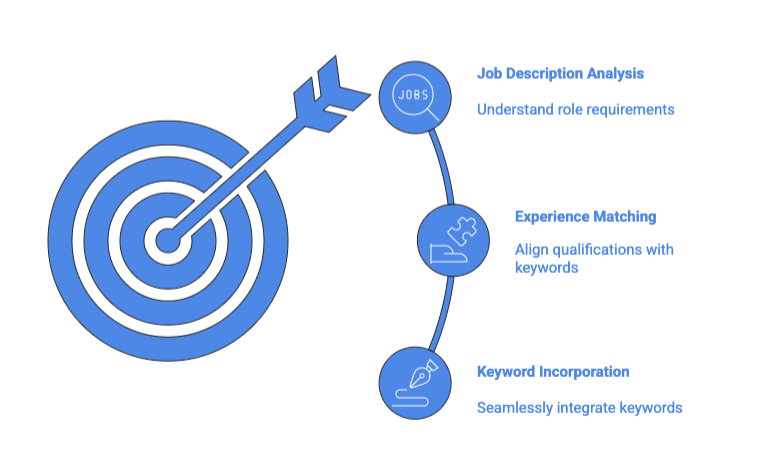
Step 1: Analyze the Job Description
Identify the 3-5 most important requirements mentioned in the job posting. These typically appear:
Step 2: Match Your Experience to Priority Keywords
Take those high-priority requirements and find corresponding examples from your background. If the job emphasizes “cross-functional collaboration,” your summary should mention leading cross-functional teams with a specific outcome.
Step 3: Incorporate Keywords Naturally
Don’t just list keywords- integrate them into achievement statements. Instead of “experienced in project management,” write “led 15+ cross-functional projects delivering $2M in cost savings.”
Before (Generic):
Copied!Experienced marketing professional with strong communication skills and proven track record of success. Team player who excels in fast-paced environments.
After (Tailored for Senior Product Marketing Manager role):
Copied!Senior Product Marketing Manager with 8+ years launching B2B software products in competitive markets. Expert in go-to-market strategy, competitive positioning, and sales enablement. Drove 45% increase in product adoption through targeted messaging and cross-functional collaboration with product, sales, and customer success teams.
The tailored version includes specific keywords from the job description (go-to-market strategy, competitive positioning, sales enablement, cross-functional collaboration) while demonstrating measurable impact.
Time Saving Tip: Using an AI resume tailoring platform like Upplai can help save you significant time tailoring your resume summary to each job description.
Resume Summary Examples by Career Level
Entry-Level Resume Summary
Recent Computer Science graduate from University of Michigan with internship experience in full-stack development and cloud infrastructure. Proficient in JavaScript, React, Node.js, and AWS. Developed mobile application serving 5,000+ users during capstone project. AWS Certified Solutions Architect – Associate.
What makes this work: Compensates for limited experience by emphasizing relevant skills, education, and a concrete project outcome. The certification adds professional credibility.
Mid-Level Resume Summary
Operations Manager with 7 years optimizing supply chain processes for manufacturing companies. Expert in Lean Six Sigma methodologies, inventory management, and vendor negotiations. Reduced operational costs by $1.2M annually through process improvements and strategic supplier partnerships. Lean Six Sigma Black Belt certified.
What makes this work: Establishes expertise through years of experience and certification while demonstrating significant financial impact—exactly what hiring managers look for at this level.
Senior-Level Resume Summary
Vice President of Sales with 15+ years building and scaling high-performance sales organizations for enterprise SaaS companies. Proven track record growing revenue from $10M to $100M+ ARR through strategic market expansion, sales process optimization, and team development. Led teams of 50+ across multiple regions, consistently exceeding quota by 120%+ annually.
What makes this work: Communicates executive-level impact through revenue growth, team leadership, and consistent performance. The specific metrics ($10M to $100M ARR, 120% quota attainment) provide concrete evidence of success.
Career Changer Resume Summary
Former High School Teacher transitioning to corporate training and development with 8 years designing curriculum and delivering engaging instruction to diverse audiences. Expert in learning management systems (Canvas, Moodle), instructional design, and performance assessment. Improved student achievement scores by 25% through innovative teaching methodologies and personalized learning approaches.
What makes this work: Bridges the gap between teaching and corporate training by emphasizing transferable skills (curriculum design, LMS platforms, instructional design) while demonstrating measurable impact.
Common Resume Summary Mistakes
| Mistake | Why It Fails | How to Fix It |
|---|---|---|
| Using clichés (“results-driven professional,” “team player”) | These phrases appear on thousands of resumes and provide no specific information about your capabilities | Replace with specific achievements: “Increased team productivity by 30% through implementation of agile workflows” |
| Writing in first person (“I am a marketing manager…”) | Sounds informal and wastes valuable space | Use third person or implied subject: “Marketing Manager with 5+ years…” |
| Making it too long (5+ sentences) | Recruiters won’t read lengthy paragraphs during initial screening | Keep to 3-4 sentences maximum, focusing on highest-impact information |
| Listing responsibilities instead of achievements | Tells what you did, not what you accomplished | Include metrics: “Managed $2M budget” becomes “Optimized $2M budget, reducing costs by 15% while maintaining quality” |
| Using the same summary for every application | Doesn’t address specific job requirements, lowering your ATS score | Customize keywords and achievements for each target role |
| Focusing on soft skills without context | Claims like “excellent communicator” are subjective and unverifiable | Demonstrate through outcomes: “Presented quarterly business reviews to C-suite executives, securing $500K in additional funding” |
How to Optimize Your Resume Summary for ATS
Applicant Tracking Systems scan your resume for keywords and rank them by importance based on the job description. Your summary is prime real estate for incorporating high-value keywords naturally.
ATS Optimization Checklist:
- Include exact job title from the posting (if you’ve held that role or equivalent)
- Use industry-specific terminology rather than generic terms
- Incorporate hard skills and tools mentioned in the job description
- Add relevant certifications that appear in requirements
- Use standard formatting (avoid tables, text boxes, or graphics in your summary)
- Include both acronyms and full terms (e.g., “ATS (Applicant Tracking System)”)
- Front-load important keywords in the first sentence when possible
Example of ATS-optimized summary:
Certified Public Accountant (CPA) with 10+ years in financial reporting, audit, and regulatory compliance for publicly traded companies. Expert in GAAP, SOX compliance, and financial systems implementation (SAP, Oracle). Led successful SOX 404 audit with zero material weaknesses for three consecutive years. Big Four accounting firm experience.
This summary includes multiple high-value keywords: CPA, financial reporting, audit, regulatory compliance, GAAP, SOX compliance, SAP, Oracle, SOX 404—all terms an ATS would prioritize for an accounting role.
The good news? You don’t need to manually identify every keyword and calculate optimal placement. AI resume builders like Upplai analyze job descriptions, identify high-priority keywords, and show you exactly where to incorporate them for maximum ATS score—while keeping your summary readable and authentic.
Quick Takeaways: Resume Summary Checklist
Use this checklist before submitting your resume:
Time-saving tip: Manual resume tailoring takes 40-60 minutes per application. If you’re applying to multiple roles, consider using an AI resume optimizer that can analyze job descriptions and suggest summary improvements in minutes while maintaining your authentic voice and giving you full control over changes.