

TLDR:
- List measurable, job-specific abilities in a dedicated Skills section near the top: programming languages, software, certifications, tools
- Additionally, include them in work experience bullets with quantified results
- Only include skills you can discuss confidently in interviews at the proficiency level you claim; remove outdated technologies and basic skills assumed for your career level
- Match the job posting’s exact terminology: if it says “JavaScript,” write “JavaScript” not “JS”; if skills appear multiple times in the posting, prioritize those in your resume
Getting rejected before a human even sees your resume? The problem might not be your experience, it’s how you’re presenting your hard skills. While 75% of large employers use Applicant Tracking Systems to filter applications, most job seekers don’t realize that ATS algorithms specifically scan for hard skills keywords that match the job description.
But before we dive in, let’s clarify: hard skills and technical skills are often used interchangeably in the job market. While ‘technical skills’ typically refers to technology-specific abilities (software, programming), it’s a subset of the broader ‘hard skills’ category. This guide covers both, helping you showcase all measurable, job-specific competencies on your resume.
What Are Hard Skills?
Hard skills are measurable, teachable abilities you’ve acquired through education, training, or hands-on work experience. Unlike soft skills (which reflect how you work), hard skills demonstrate what you can do.
You’ll also hear these called ‘technical skills,’ especially in tech-focused industries. Whether a job posting asks for ‘hard skills,’ ‘technical skills,’ or ‘technical competencies,’ they’re looking for the same thing: specific, measurable abilities you can demonstrate.
Key characteristics of hard skills:
Common examples across industries:
| Industry | Hard Skills Examples |
|---|---|
| Technology | Python, Java, AWS, SQL, React, Docker, Kubernetes |
| Marketing | Google Analytics, SEO/SEM, HubSpot, A/B testing, Salesforce |
| Finance | Financial modeling, Excel (pivot tables, VLOOKUP), QuickBooks, SAP |
| Design | Adobe Creative Suite, Figma, Sketch, HTML/CSS, UI/UX principles |
| Healthcare | Electronic Health Records (EHR), HIPAA compliance, CPR certification |
| Sales | CRM software (Salesforce, HubSpot), lead generation, contract negotiation |
The distinction matters because ATS algorithms are programmed to identify hard skills first. A resume lacking the specific technical skills mentioned in a job description gets filtered out, regardless of how impressive your soft skills or achievements might be.
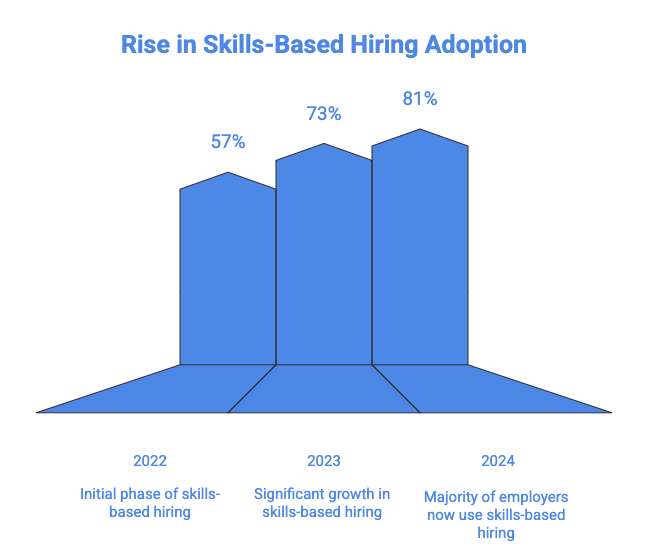
Additionally, hard skills are becoming increasingly important during recruiter screening as 81% of employers now use skills-based hiring, up from 73% in 2023 and 57% in 2022.
Hard Skills vs. Soft Skills: Understanding the Difference
While both skill types matter, they serve different purposes in your job search and require different presentation strategies.
Hard Skills (Technical Skills):
Soft Skills:
Why the distinction matters for your resume:
Hard skills and technical skills get you past the ATS. They’re the keywords algorithms scan for when filtering applications. If the job description lists “SQL” and “data visualization” but your resume only mentions “strong analytical abilities,” you’ll likely get rejected before a human reviews your application.
Soft skills get you the interview. Once a recruiter reviews your resume, they look for evidence that you can apply your technical abilities effectively. This is where soft skills appear which you can woven into your achievement-focused bullet points.
The strategic approach: Lead with hard skills in your skills section and job titles, then demonstrate soft skills through your accomplishments. For example:
Data Analyst
ABC Corporation | 2023–2026
• Built automated reporting dashboards using Tableau and SQL, reducing report generation time by 60% and enabling executives to make data-driven decisions three times faster
• Led a cross-functional team of five to implement a new Python-based data pipeline, improving data accuracy from 87% to 99.2%
Notice how hard skills (Tableau, SQL, Python) are explicitly named, while soft skills (leadership, efficiency, problem-solving) are demonstrated through the achievement context.
The Most In-Demand Hard Skills by Industry
The hard/technical skills that matter most depend on your industry, role level, and career trajectory. Here’s what employers are actively seeking in 2026:
Technology & Engineering
Marketing & Communications
Finance & Accounting
Design & Creative
Project Management
Career level considerations:
Entry-level (0-3 years): Focus on foundational technical skills and certifications. Employers expect proficiency in 3-5 core tools relevant to your field.
Mid-level (4-10 years): Demonstrate advanced proficiency in specialized tools plus emerging technologies. Show progression from basic to advanced skill application.
Senior-level (10+ years): Emphasize strategic technical skills, architecture-level knowledge, and expertise in multiple related technologies. Include leadership of technical initiatives.
Where to Include Hard Skills on Your Resume
Strategic placement of hard skills determines whether your resume passes ATS filters and catches recruiter attention. Here’s how to optimize each section:
1. Skills Section (Most Critical for ATS)
Create a dedicated skills section near the top of your resume, typically right after your summary or objective. This is where ATS algorithms scan first.
Effective formatting options:
Option A: Categorized by skill type
Technical Skills
Programming: Python, JavaScript, SQL, R
Data Analysis: Tableau, Power BI, Google Analytics, Excel (advanced)
Cloud Platforms: AWS (EC2, S3, Lambda), Azure, Google Cloud
Tools: Git, Docker, Kubernetes, Jenkins
Option B: Simple list format
Core Competencies
Python | SQL | Tableau | AWS | Machine Learning | Data Visualization | Statistical Analysis | A/B Testing | ETL Processes | Agile Methodology
What NOT to do:
2. Professional Experience (Prove Your Skills)
List your hard skills and technical skills in your bullet points, but always within the context of achievements. This shows you didn’t just learn the skill, you applied it to create measurable results.
✅ Strong example:
Developed automated data pipeline using Python and Apache Airflow, processing 2M+ records daily and reducing manual data entry time by 15 hours per week
❌ Weak example:
Used Python and Apache Airflow for data processing
The difference? The strong example quantifies the impact and demonstrates scale. It proves you didn’t just use the tool, you solved a real business problem with it.
3. Certifications & Education
Hard skills backed by formal credentials carry extra weight. Create a dedicated section for certifications if you have multiple relevant ones.
Certifications
• AWS Certified Solutions Architect – Associate | Amazon Web Services | 2024
• Google Analytics Individual Qualification (GAIQ) | Google | 2026
• Project Management Professional (PMP) | PMI | 2023
4. Resume Summary (Strategic Keyword Placement)
Your summary provides another opportunity to include 3-5 of your most important hard skills, especially those that appear multiple times in the job description.
Example:
Senior Data Analyst with 8+ years of experience leveraging SQL, Python, and Tableau to transform complex datasets into actionable business insights. Proven track record of building automated reporting systems that reduced analysis time by 40% while improving data accuracy to 99.5%.
How to Identify Which Technical Skills to Include on Your resume
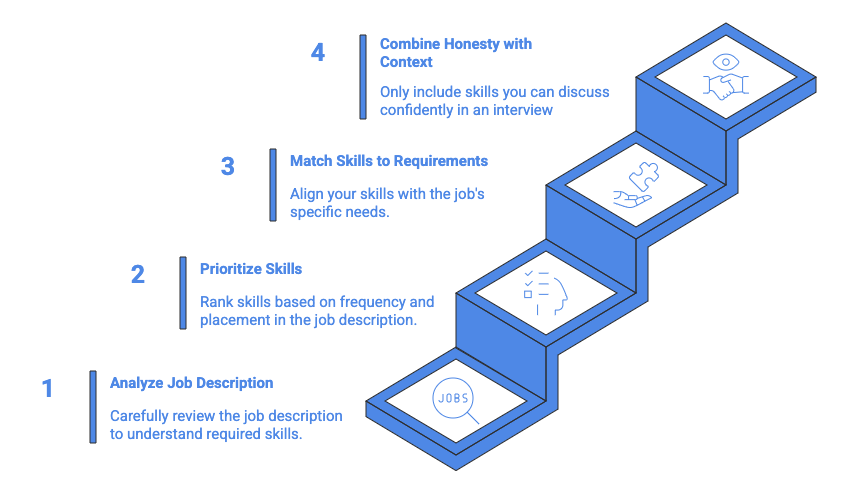
The biggest mistake job seekers make? Using the same skills section for every application. Here’s how to tailor your hard skills strategically:
Step 1: Analyze the Job Description
Job descriptions contain explicit and implicit hard skills requirements. Extract both.
Explicit skills appear in sections like:
Implicit skills appear in:
Step 2: Prioritize by Frequency and Placement
Skills mentioned multiple times or in the first paragraph carry more weight. If “Python” appears five times and “R” appears once, prioritize Python.
Step 3: Match Your Skills to Job Requirements
Create a two-column comparison:
| Job Description Requirement | Your Matching Skill |
|---|---|
| “Proficiency in SQL required” | SQL (5 years, advanced) |
| “Experience with data visualization tools” | Tableau, Power BI |
| “Cloud platform experience preferred” | AWS (EC2, S3, RDS) |
| “Agile methodology” | Certified ScrumMaster, 3 years Agile |
Step 4: Be Honest About Proficiency Levels
Only include skills you can discuss confidently in an interview. If you took one Python course three years ago, don’t list it as a core skill.
Proficiency framework:
Time Saving Tip
AI resume optimization platforms like Upplai can automate this analysis process, instantly identifying which hard skills from the job description match your background and which ones you’re missing. The platform ranks each skill by importance (high, medium, low) so you know which gaps matter most, while saving you valuable time.
Common Hard Skills Mistakes That Get Resumes Rejected
Even experienced professionals make these critical errors that trigger ATS rejection:
Mistake #1: Using Different Terminology Than the Job Description
❌ The problem: You list “JavaScript” but the job description asks for “JS.” Or you write “Search Engine Optimization” when they wrote “SEO.”
✅ The fix: Mirror the exact terminology used in the job description. If they abbreviate, you abbreviate. If they spell it out, you spell it out. Many ATS systems don’t recognize variations.
Mistake #2: Listing Outdated or Irrelevant Skills
❌ The problem: Your resume still lists “Microsoft Office” as a hard skill when you’re applying for senior roles, or includes technologies you haven’t used in 10 years.
✅ The fix: Remove basic skills that are assumed for your career level. Focus on specialized, current technologies. If you haven’t used a skill in 5+ years, it probably doesn’t belong on your resume unless it’s specifically requested.
Mistake #3: Keyword Stuffing Without Substance
❌ The problem: Loading your skills section with every technology mentioned in the job description, even ones you barely know, hoping to pass ATS filters.
✅ The fix: Only list skills you can discuss in detail during an interview. Recruiters will ask follow-up questions, and getting caught exaggerating is worse than not making it past the ATS.
Mistake #4: Burying Important Skills in Paragraphs
❌ The problem: Mentioning critical hard skills only within dense paragraph descriptions where recruiters might miss them.
✅ The fix: Always include your most important hard skills in both your dedicated skills section AND your experience bullets. Redundancy helps with both ATS and recruiter screening.
Mistake #5: Ignoring Industry-Specific Terminology
❌ The problem: Using generic terms like “project management software” instead of specific tools like “Jira” or “Asana” that appear in job descriptions.
✅ The fix: Be specific. Name the actual tools, platforms, and technologies. “CRM software” is vague; “Salesforce Sales Cloud” is precise and ATS-friendly.
✓ Quick Takeaways: Hard Skills Checklist
Use this checklist before submitting your next application:
Skills Section:
Experience Section:
Overall Resume:
Tailoring: