

TLDR:
- Don’t list soft skills separately; instead, embed them within achievement bullet points using the CAR framework
- Identify which soft skills to include by analyzing the job description for explicit mentions and implicit requirements, then use the exact keywords from the posting
- Match soft skills to career level: entry-level emphasizes coachability and teamwork, mid-level shows initiative and mentorship, senior-level demonstrates strategic thinking and change management
- Avoid generic buzzwords and skills lists without evidence; every soft skill claim needs concrete proof with metrics showing the impact of applying that skill in real scenarios
Soft skills have become the deciding factor between candidates with similar technical qualifications. While hard skills prove you can do the job, soft skills determine whether you’ll thrive in the role and fit the company culture. Yet most job seekers struggle to showcase these intangible qualities effectively on their resumes.
Why Soft Skills Matter on Your Resume
Hiring managers spend an average of 7 seconds scanning resumes. In that brief window, they’re not just looking for technical expertise, they’re evaluating whether you’ll collaborate effectively, adapt to challenges, and contribute to team dynamics.
Here’s the reality: 92% of talent professionals say soft skills matter as much as or more than hard skills, according to LinkedIn’s Global Talent Trends report. Yet 89% report having difficulty finding candidates with the right soft skills.
This gap creates opportunity. When you effectively showcase relevant soft skills on your resume, you differentiate yourself from candidates who only list technical qualifications.
The ATS Factor
Applicant Tracking Systems scan for both hard and soft skills mentioned in job descriptions. If a posting emphasizes “cross-functional collaboration” or “stakeholder management,” those exact phrases need to appear in your resume, but not just as a list. ATS algorithms increasingly evaluate context, looking for evidence that you’ve applied these skills in real scenarios.
The Top Soft Skills Employers Want in 2026
Not all soft skills carry equal weight. Based on analysis of thousands of job postings across industries, these soft skills appear most frequently in hiring manager requirements:
| Soft Skill | Why It Matters | Industries That Prioritize It |
|---|---|---|
| Communication Skills | Translates complex ideas, writes clearly, presents effectively | All industries, especially tech, healthcare, consulting |
| Problem-Solving | Identifies issues, develops solutions, thinks critically | Engineering, operations, product management |
| Adaptability | Adjusts to change, learns quickly, handles ambiguity | Startups, tech, fast-paced environments |
| Leadership | Influences without authority, mentors others, drives initiatives | Management, project-based roles, team leads |
| Teamwork | Collaborates across functions, builds consensus, shares credit | Cross-functional roles, agile environments |
| Time Management | Prioritizes effectively, meets deadlines, manages multiple projects | All industries, especially client-facing roles |
| Emotional Intelligence | Reads situations, manages relationships, demonstrates empathy | HR, customer success, healthcare, education |
| Critical Thinking | Analyzes data, evaluates options, makes sound decisions | Strategy, analytics, senior leadership |
Industry-Specific Priorities
Different sectors emphasize different interpersonal skills:
How to Identify Which Soft Skills to Include on a Resume
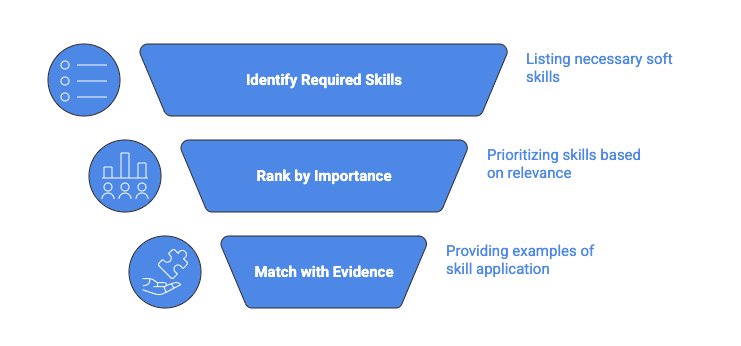
The biggest mistake job seekers make? Listing generic soft skills that don’t align with the specific role. Here’s how to identify which soft skills to emphasize:
Step 1: Analyze the Job Description
Job postings reveal exactly what hiring managers value. Look for:
Step 2: Rank by Importance
Not every soft skill mentioned deserves equal emphasis. Pay attention to:
Step 3: Match Your Evidence
For each priority soft skill, ask yourself:
If you can’t provide evidence, don’t include that skill. Hiring managers can spot empty claims instantly.
The AI Advantage
AI resume builders like Upplai analyze job descriptions to identify which soft skills matter most for specific roles, then scan your resume to highlight where you’ve demonstrated these skills, even if you didn’t explicitly label them. This helps surface relevant experience you might overlook.
Best Practices: How to Include Soft Skills on a Resume
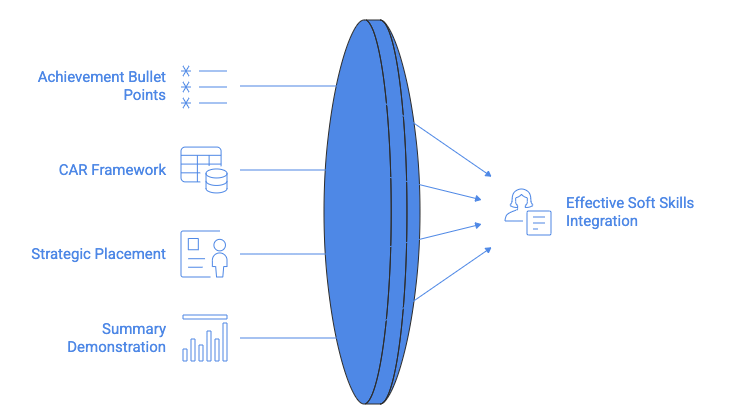
Listing “excellent communication skills” in the skills section accomplishes nothing. Hiring managers need proof. Here’s how to demonstrate soft skills effectively:
Method 1: Integrate Into Achievement Bullet Points
The most powerful approach embeds soft skills within quantified accomplishments:
❌ Weak:
Copied!"Good at problem-solving and teamwork"
✅ Strong:
Copied!Led a cross-functional team of 8 to resolve a critical production issue, reducing system downtime by 40% through collaborative root-cause analysis and implementation of preventive protocols
This bullet demonstrates teamwork, leadership, problem-solving, and analytical thinking without explicitly naming them.
Method 2: Use the CAR Framework
Context-Action-Result (CAR) bullet points naturally showcase soft skills:
Example:
Copied!Context: Inherited an underperforming sales territory with 18% customer churn Action: Rebuilt client relationships through weekly check-ins, implemented a feedback system, and trained junior team members on a consultative selling approach Result: Reduced churn to 6% and increased territory revenue by $2.3M within 12 months
This demonstrates relationship management, communication skills, mentorship, and strategic thinking.
Method 3: Strategic Skills Section Placement
A dedicated soft skills section works when:
Format it properly:
Copied!Core Competencies • Stakeholder Management: Built consensus among C-suite executives across three business units for enterprise software implementation • Change Management: Led an organizational transition affecting 200+ employees, achieving a 94% adoption rate within six months
Notice each skill includes brief evidence, not just the label.
Method 4: Demonstrate in Your Professional Summary
Your resume summary offers prime real estate to establish your soft skills profile:
❌ Generic: “Results-driven professional with strong communication and leadership skills”
✅ Specific:
Copied!
Learn how to list your skills on a resume and balance technical and soft skills effectively.
Soft Skills By Career Level
The soft skills that matter most evolve as you advance in your professional career:
Entry-Level Positions
Hiring managers expect:
How to demonstrate: Focus on academic projects, internships, volunteer work, or part-time jobs where you collaborated, learned quickly, or solved problems.
Mid-Level Positions
Expectations shift to:
How to demonstrate: Highlight cross-functional projects, training initiatives, process improvements, and situations where you drove results through others.
Senior/Executive Positions
Leadership soft skills dominate:
How to demonstrate: Focus on organizational impact, culture change, board-level communication, and situations requiring political savvy.
Common Mistakes When Adding Soft Skills to Resumes
Mistake 1: Generic Skills Lists
Don’t do this:
Copied!Skills: Communication, Leadership, Teamwork, Problem-solving, Time management
This tells hiring managers nothing. Everyone claims these skills. Without context or evidence, these words are meaningless filler.
Mistake 2: Mismatched Skills
Including “team collaboration” when the job description emphasizes “independent work” signals you didn’t read the posting carefully. Always align your soft skills with the role’s actual requirements.
Mistake 3: Overusing Buzzwords
“Synergistic team player with out-of-the-box thinking” sounds like corporate jargon bingo. Use plain language that describes actual behaviors and outcomes instead of buzzwords.
Mistake 4: Neglecting Keywords
If the job description says “stakeholder management,” don’t substitute “relationship building.” ATS systems look for exact or very close keyword matches. Use the employer’s language.
Mistake 5: Claiming Contradictory Skills
“Detail-oriented” and “big-picture thinker” in the same resume can seem contradictory unless you provide context showing when you apply each skill appropriately.
Resume Soft Skills Examples by Industry
Technology/Engineering
Copied!• Mentored 5 junior engineers through code reviews and pair programming sessions, improving team code quality scores by 35% • Translated technical architecture decisions into business impact presentations for non-technical executives, securing $500K infrastructure investment • Adapted development approach mid-sprint when client requirements shifted, delivering modified solution 2 weeks ahead of revised deadline
Soft skills demonstrated: Mentorship, communication skills, adaptability, technical translation
Healthcare
Copied!• Managed care for 6-8 patients simultaneously in high-acuity unit, prioritizing interventions based on clinical urgency while maintaining empathetic patient communication • De-escalated 15+ emotionally charged family situations through active listening and clear explanation of treatment plans • Collaborated with interdisciplinary team of physicians, therapists, and social workers to develop comprehensive discharge plans, reducing 30-day readmissions by 22%
Soft skills demonstrated: Time management, empathy, communication skills, teamwork, stress management
Sales/Business Development
Copied!• Built trusted advisor relationships with C-suite executives at 12 enterprise accounts, resulting in 340% increase in average deal size • Overcame 8-month procurement stall through persistent follow-up and creative problem-solving, ultimately closing $1.2M contract • Adapted sales approach for technical vs. business stakeholders, tailoring presentations to each audience's priorities and concerns
Soft skills demonstrated: Relationship building, persistence, adaptability, communication skills
Time Saving Tip
Soft skills only make an impact when they’re relevant to the job and you provide the full context on how you demonstrated them through achievement focused language. However, tailoring your resume to highlight your soft skills for each job can take significant time. AI resume optimization platforms like Upplai can help you save time and highlight the job-specific soft skills to get you immediate recruiter attention.
Quick Takeaways: Soft Skills Checklist
Use this checklist when optimizing your resume: