


TLDR:
- Include both hard skills and soft skills by demonstrating them through quantified achievements in your work experience, not just listing them
- Place skills strategically: mention 2-3 key skills with metrics in your resume summary, integrate throughout work experience bullets with specific examples, or create a dedicated skills section organized by category
- Match job description keywords exactly for ATS: if posting says “Salesforce CRM,” write “Salesforce CRM” not “customer database”; analyze the posting to identify skills mentioned multiple times and prioritize those in your resume
Good customer service keeps customers coming back, and companies know it. With 365,300 openings for customer service representatives projected annually despite a 5% employment decline through 2034 due to automation, proves that having the right skills matters more than ever.
But here’s the problem: most people just list generic skills like “excellent communication” or “team player” without any proof. Recruiters see right through it. That’s why this guide will walk you through the exact customer service skills recruiters look for and how to showcase them in a way that actually gets you hired.
Why Customer Service Skills Matter on Your Resume
Recruiters spend an average of 7 seconds on initial resume reviews. In that brief window, they’re scanning for proof that you can handle customer interactions, resolve conflicts, and contribute to customer satisfaction metrics that impact the bottom line.
Here’s what makes customer service skills particularly critical:
The challenge? Most job seekers list customer service skills without context, making it impossible for recruiters to assess their actual capabilities. Your resume needs to show how you applied these skills and what results you achieved.
For comprehensive guidance on passing ATS filters, refer to our ATS optimization guide
The Two Categories of Customer Service Skills
Hard Skills (Technical Competencies)
Hard skills are measurable, teachable abilities specific to customer service operations. These include:
| Hard Skill | Why It Matters | ATS Keywords to Use |
|---|---|---|
| CRM Software | Tracks customer interactions and history | Salesforce, Zendesk, HubSpot, Freshdesk |
| Help Desk Systems | Manages support tickets efficiently | ServiceNow, Jira Service Desk, Zoho Desk |
| Data Entry & Management | Maintains accurate customer records | Data accuracy, database management, record keeping |
| Product Knowledge | Enables effective troubleshooting | Technical support, product expertise, troubleshooting |
| Point of Sale (POS) Systems | Processes transactions smoothly | POS systems, payment processing, transaction management |
| Live Chat Support | Provides real-time assistance | Live chat, instant messaging, chat support |
| Multi-channel Support | Handles phone, email, chat, social media | Omnichannel support, multi-platform communication |
These are your baselines. The tools and systems you actually need to do the job. Companies screen for these first because they’re straightforward to verify. Either you know Salesforce, or you don’t. But the best part is that hard skills are totally learnable. You can take an online course, get certified, practice with free trials, or pick them up during onboarding. Most companies expect to train you on their specific systems anyway.
Soft Skills (Interpersonal Abilities)
Soft skills determine how effectively you connect with customers and handle real-world situations. Here’s what makes them different from hard skills:
The most valued soft skills in customer service include communication, problem-solving, empathy and emotional intelligence, time management, and conflict resolution. These foundational skills show up in virtually every customer service job description, though how you apply them varies by role and industry.
We’ve covered in-depth explanations with practical resume examples for the top 12 customer service skills later in this guide, so you’ll see exactly how to demonstrate these abilities on your resume.
How to Identify Which Skills to Include
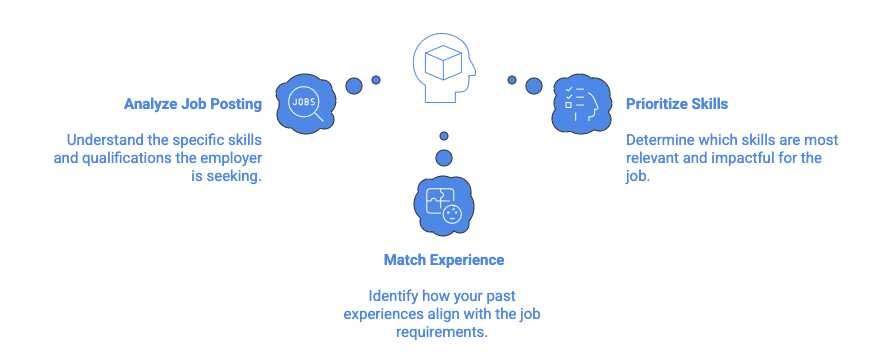
Don’t list every customer service skill you possess. Instead, tailor your resume to match each specific job description.
Step 1: Analyze the Job Posting
Read the job description carefully and identify:
Step 2: Match Your Experience to Their Needs
Create a two-column comparison:
Focus on skills where you have concrete examples and measurable results.
Step 3: Prioritize by Importance
Not all skills carry equal weight. Rank them as:
Include high-importance skills in your resume summary, work experience bullet points, and a dedicated skills section.
Where to Place Customer Service Skills on Your Resume
Resume Summary (Top of Page)
Your resume summary should immediately establish your customer service expertise with 2-3 key skills and a quantifiable achievement:
SUMMARY
Customer Service Professional with 6+ years managing high-volume support operations. Expert in CRM systems (Salesforce, Zendesk) and conflict resolution, with proven track record of improving customer satisfaction scores by 28% and reducing average resolution time from 48 to 24 hours.
Professional Experience Section
This is where skills come to life through specific examples in your work experience section. Use the achievement-focused format:
Action Verb + Task + Metric/Result
✅ Strong examples:
❌ Weak examples (avoid these):
Dedicated Skills Section
Create a scannable section titled ‘Skills’ or ‘Core Competencies’ near the top or bottom of your resume:
SKILLS
• Technical: Salesforce CRM, Zendesk, Microsoft Office Suite, LiveChat, multi-line phone systems
• Customer Relations: Conflict resolution, active listening, relationship building, customer retention
• Operational: Time management, multitasking, data analysis, quality assurance, process improvement
The 12 Most Valuable Customer Service Skills for 2026
Based on current job market analysis, these skills appear most frequently in customer service job postings and correlate with higher interview rates:
1. Active Listening
This is about truly hearing what customers are saying, not just waiting for your turn to talk. When you catch the real issue in the first 30 seconds instead of making assumptions, you save everyone time and frustration.
Example of active listening on a resume:
Reduced customer call times by 15% by carefully listening to identify key concerns at the start of interactions and immediately providing actionable solutions
2. Empathy
It’s the secret sauce that transforms angry customers into loyal fans. There’s a world of difference between robotically saying “I’ll help you” and genuinely making someone feel heard and understood.
Example of empathy on a resume:
Supported and reassured customers during system outages, helping decrease escalations by 30% through genuine understanding and proactive communication.
3. Clear Communication
Nobody wants to feel like they need a PhD to understand your explanation. Whether you’re on the phone, writing an email, or chatting live, keep it simple and jargon-free.
Examples of clear communication on a resume:
• Increased customer satisfaction scores by 10% through clear and concise email responses that addressed all customer questions within 24 hours.
• Developed simplified troubleshooting guides that reduced customer confusion and follow-up inquiries by 40%.
4. Problem-Solving
Sometimes the solution is right there in the manual. Other times? You’ll need to get creative. The best customer service reps know which approach each situation needs.
Examples of problem-solving on a resume:
• Resolved customer billing discrepancies by investigating account histories and collaborating with the finance department, achieving a 98% resolution rate.
• Proactively identified potential service disruptions and developed contingency plans to ensure service continuity and minimize customer impact.
5. Patience
Yes, even when someone asks the same question three times. Taking that extra moment to explain things calmly prevents mistakes and those dreaded follow-up calls.
Example of patience on a resume:
Maintained composure while assisting elderly customers with technical setup, resulting in a 4.9/5.0 satisfaction rating and numerous positive reviews praising patience and clarity.
6. Product Knowledge
You can’t fake this one. Customers can tell when you really know your stuff versus when you’re frantically Googling answers. Deep product expertise builds trust fast.
Example of product knowledge on a resume:
Leveraged deep product expertise to resolve 92% of technical support inquiries on first contact, eliminating need for escalations and callbacks.
7. Time Management
It’s the art of being efficient without making customers feel rushed. This means:
- Juggling phone calls, emails, and chats like a pro
- Knowing which fires to put out first
- Hitting your targets while still giving each customer proper attention
Examples of time management on a resume:
• Simultaneously managed phone, email, and live chat inquiries, maintaining a 95% customer satisfaction rate while handling 60+ daily interactions across multiple channels.
• Prioritized urgent customer issues during peak holiday season, reducing average wait times by 35% without compromising service quality.
8. Conflict Resolution
Think of it as being a professional peacemaker. Stay calm when tensions rise, acknowledge their frustration (because it’s real!), and work toward solutions that make everyone reasonably happy.
Examples of conflict resolution on a resume:
• De-escalated 85% of customer complaints through active listening and empathetic problem-solving, preventing escalation to management.
• Transformed 73% of dissatisfied customers into positive reviews by addressing concerns promptly and offering fair resolutions.
9. Adaptability
Every customer is different. Some want all the details, others just want the quick fix. Reading the room (or the chat) and adjusting your style accordingly is key.
Example of adaptability on a resume:
Quickly adapted to new AI chatbot system during company-wide rollout, becoming team resource and training 8 colleagues on the platform within two weeks.
10. Attention to Detail
One tiny error in a customer’s account can snowball into a mess later. Double-checking information now saves major headaches down the road.
Example of attention to detail on a resume:
Maintained 99.7% data accuracy across 1,000+ customer records by implementing double-check protocols, preventing billing errors and service interruptions.
11. Positive Attitude
Here’s the thing: customers can actually hear when you’re smiling on the phone. And they definitely pick up on negativity in emails. A genuinely upbeat approach makes tough conversations so much easier.
Example of positive attitude on a resume:
Consistently received customer feedback mentioning “friendly,” “helpful,” and “pleasant” interactions, contributing to team’s highest-ever satisfaction scores of 4.8/5.0.
12. Technical Proficiency
Modern customer service means having five tabs open while talking to someone on the phone and chatting with another customer simultaneously. If you can navigate multiple systems without breaking a sweat, you’re golden.
Example of technical proficiency on a resume:
• Configured automated email responses and chatbot workflows, reducing response times by 45% and freeing team capacity for complex issues.
• Mastered Salesforce CRM, Zendesk, and internal knowledge base systems within first month, enabling efficient handling of complex multi-system customer inquiries.
Pro tip: Always quantify your achievements with specific metrics like satisfaction scores, resolution rates, volume handled, or revenue impact. Numbers make your claims credible and memorable. If you don’t have exact numbers, use reasonable estimates based on your typical workload. “Approximately 50 calls daily” or “dozens of customer interactions per shift” is better than no numbers at all.
Common Mistakes When Listing Customer Service Skills
Mistake 1: Generic Skill Lists Without Context
❌ Wrong:
Copied!Skills: Communication, teamwork, problem-solving, customer service
✅ Right:
Copied!• Utilized active listening and empathy to de-escalate 40+ customer complaints monthly, achieving 89% resolution without supervisor intervention
Mistake 2: Focusing on Duties Instead of Achievements
❌ Wrong:
Copied!• Answered customer phone calls and emails • Handled customer complaints
✅ Right:
Copied!• Managed 60+ daily customer inquiries across phone, email, and live chat channels while maintaining 4.7/5.0 satisfaction rating • Transformed 73% of customer complaints into positive reviews through empathetic problem-solving and follow-up communication
Mistake 3: Ignoring ATS Keywords
Many qualified candidates get filtered out because their resumes don’t include exact keywords from the job description. If the posting mentions “CRM software,” don’t just write “customer database”, use their exact terminology.
Also, manually matching keywords for each application can take anywhere from 30-45 minutes. AI resume builders like Upplai automatically scan job descriptions, identify missing ATS keywords, and suggest exactly where to add them, reducing this process to under 2 minutes while ensuring you don’t miss critical terms.
Mistake 4: Overloading Soft Skills Without Technical Balance
Listing only interpersonal skills makes you seem like you lack technical competence. Balance soft skills (empathy, communication) with hard skills (Salesforce, data analysis, specific software).
Mistake 5: Using Outdated or Irrelevant Skills
Skills like “10-key calculator” or “fax machine operation” date your resume. Focus on current technologies and methodologies relevant to modern customer service.
Customer Service Resume Examples
Example 1: Entry-Level Customer Service Representative
Professional Experience
Customer Service Associate | RetailCo | June 2026 – Present
• Assist 40+ customers daily with product inquiries, returns, and technical troubleshooting, maintaining a 4.6/5.0 satisfaction rating
• Process point-of-sale transactions with 99.8% accuracy while managing a multi-line phone system and in-person service simultaneously
• De-escalate customer complaints using active listening and empathy, resolving 85% of issues without manager involvement
• Recognized as “Employee of the Month” twice for exceeding customer service targets and demonstrating exceptional problem-solving skills
Technical Skills
Technical: POS systems, Microsoft Office, inventory management software, multi-line phones
Customer Relations: Active listening, conflict resolution, relationship building, patience, positive attitude
Operational: Time management, multitasking, attention to detail, cash handling, organization
Why This Works:
Every bullet point includes specific metrics (4.6/5.0 rating, 99.8% accuracy, 85% resolution rate) that prove your capabilities, not just claim them. The skills section balances technical abilities with soft skills, and the “Employee of the Month” recognition adds credibility. Perfect for candidates with limited experience who need to demonstrate real impact.
Example 2: Senior Customer Service Manager
Professional Experience
Customer Service Manager | TechSolutions Inc. | March 2026 – Present
• Lead a team of 15 customer service representatives supporting 2,000+ B2B clients, improving department NPS from 38 to 72 within 18 months
• Implemented Salesforce CRM and developed a training program, reducing average ticket resolution time by 35% and increasing first-contact resolution to 91%
• Analyzed customer feedback data to identify service gaps, resulting in three process improvements that decreased customer churn by 24%
• Managed escalated complaints and at-risk accounts, personally retaining $1.2M in annual revenue through strategic relationship management
• Conduct quarterly training sessions on conflict resolution, empathy, and technical product knowledge for customer-facing staff across four departments
Technical Proficiencies
Salesforce CRM • Zendesk • Microsoft Dynamics • Tableau • Google Analytics • Slack • Zoom • Multi-channel support platforms
Why This Works:
This example leads with impressive numbers that matter to employers: NPS jumped from 38 to 72, $1.2M in retained revenue, and 35% faster resolution times. It demonstrates leadership through team management, system implementation, and strategic analysis. The extensive technical proficiencies show you can operate advanced tools immediately. Ideal for senior-level positions requiring proven transformation results.
Quick Checklist: Optimizing Customer Service Skills on Your Resume
Use this checklist before submitting your application: