


TLDR:
- Demonstrate leadership through quantified achievements using [Action verb] + [What you did] + [Measurable result]
- Show leadership at any level: entry-level emphasizes initiative and peer collaboration, mid-level shows team management and cross-functional influence, senior-level demonstrates organizational transformation and strategic business impact
- Place leadership evidence in your work experience section with strong action verbs, match keywords in a dedicated skills section, and optionally summarize in your professional profile
- Include informal leadership if you lack manager titles: leading projects, training colleagues, driving process improvements, or coordinating cross-functional work all demonstrate leadership capabilities employers value
Leadership skills aren’t just for managers. Whether you’re applying for your first job or a C-suite position, demonstrating leadership on your resume can set you apart from other candidates, even if you’ve never had “manager” in your job title.
The challenge? Most job seekers either bury their leadership experience in generic bullet points or assume they don’t have leadership skills worth mentioning. Both approaches cost you interviews.
What Are Leadership Skills and Why Do Employers Care?
Leadership skills are the abilities that enable you to guide, influence, and motivate others toward achieving goals, whether you’re managing a team of 50 or collaborating with two colleagues on a project.
Here’s what matters: 75% of long-term job success depends on people
skills, yet most resumes fail to demonstrate these abilities with concrete evidence.
Leadership encompasses several interconnected professional skills:
| Leadership Skill Category | What It Includes | Why Employers Value It |
|---|---|---|
| Communication Skills | Active listening, presentation, written communication, feedback delivery | Reduces misunderstandings, improves team performance by 25% |
| Decision-Making | Problem analysis, risk assessment, strategic thinking | Directly impacts project outcomes and business results |
| Influence | Persuasion, negotiation, stakeholder management | Drives cross-functional collaboration without formal authority |
| Mentorship | Coaching, knowledge transfer, talent development | Builds organizational capability and reduces turnover |
| Adaptability | Change management, resilience, learning agility | Critical in fast-moving industries and during organizational change |
| Innovation | Creative problem-solving, process improvement, strategic vision | Separates high performers from average employees |
| Organizational Skills | Project management, prioritization, resource allocation | Ensures deadlines are met and quality is maintained |
| Empathy | Emotional intelligence, conflict resolution, team building | Creates psychological safety that improves team productivity |
| Self-Awareness | Recognizing strengths/weaknesses, seeking feedback, continuous improvement | Foundation for all other leadership abilities |
Leadership Skills by Career Level: What to Emphasize
Different career stages require different leadership demonstrations. Here’s what to highlight based on where you are:
Entry-Level Resume: Proving Leadership Potential
You don’t need management experience to show leadership. Focus on:
Initiative and ownership:
Collaboration and influence:
Learning agility:
Example entry-level bullet points:
• Initiated a peer onboarding program that reduced new hire ramp-up time by 30%, training 12 team members on internal systems and processes
• Collaborated with marketing and sales teams to redesign the customer feedback process, resulting in a 40% increase in survey response rates
• Identified recurring data entry errors and proposed automated validation system, reducing errors by 65% and saving 5 hours per week
Mid-Level Resume: Demonstrating Proven Leadership
At this stage, you should show both direct management skills and the ability to influence without authority:
Team leadership:
Strategic thinking:
Cross-functional influence:
Example mid-level bullet points:
• Led cross-functional team of 8 (engineering, design, marketing) to launch new product feature, delivering 2 weeks ahead of schedule and achieving 150% of adoption targets in first quarter
• Mentored 4 junior analysts, with 3 promoted within 18 months; developed training curriculum now used department-wide for new hires
• Drove organizational change initiative affecting 50+ employees, securing executive buy-in and achieving 85% adoption rate within 6 months through strategic communication and stakeholder engagement
Senior-Level Resume: Showcasing Strategic Leadership
Executive and senior leadership resumes should emphasize organizational impact, vision, and business results:
Organizational transformation:
Business impact:
Thought leadership:
Example senior-level bullet points:
• Transformed underperforming 120-person division, rebuilding leadership team and implementing new performance management system that improved employee engagement scores by 45% and increased revenue by $8M (22%) within 18 months
• Established company’s first formal mentorship program, pairing 60 high-potential employees with senior leaders, resulting in 30% improvement in internal promotion rates and 15% reduction in regrettable attrition
• Spearheaded strategic pivot into adjacent market, building business case that secured $12M investment, recruiting and leading 25-person team, and delivering $18M in new revenue within first year
Where to Place Leadership Skills on Your Resume
Strategic placement matters as much as the content itself. Applicant tracking systems and recruiters both scan specific sections for leadership indicators.
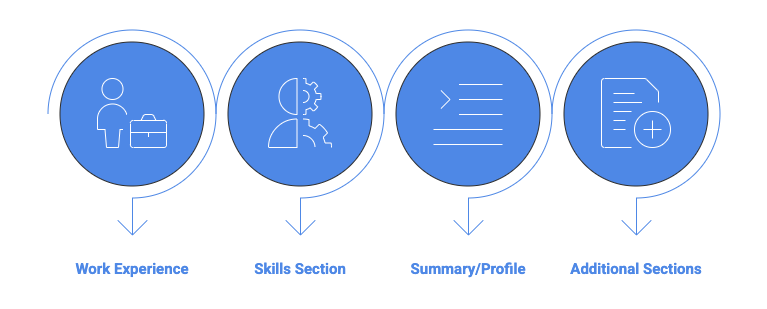
1. Work Experience Section (Primary Location)
The work experience section on your resume is where leadership skills carry the most weight. Every bullet point in your work experience should follow this formula:
[Action Verb] + [What You Did] + [Quantifiable Result/Impact]
Strong leadership action verbs include:
2. Skills Section (Strategic Keywords)
Include a dedicated skills section with relevant leadership skills to quickly highlight these skills for recruiters and to optimize for ATS. Match the language used in the job description:
Example skills section:
Leadership & Management: Team leadership, cross-functional collaboration, stakeholder management, change management, performance management
Core Competencies: Strategic planning, decision-making, conflict resolution, mentorship and coaching, project management
3. Summary or Profile (Optional but Powerful)
For mid to senior-level positions, a brief professional summary can immediately establish your leadership credentials:
Results-driven marketing leader with 10+ years of experience building and scaling high-performing teams. Proven track record of driving 40%+ revenue growth through strategic campaign development, cross-functional collaboration, and data-driven decision-making. Known for developing talent, five direct reports promoted to leadership roles in the past three years.
4. Additional Sections (Supporting Evidence)
Depending on your background, these sections can reinforce leadership:
How to Write Leadership Bullet Points That Get Interviews
Generic statements like “Excellent leadership skills” or “Strong team player” tell recruiters nothing. Here’s how to transform weak bullet points into compelling evidence:
Before and After Examples
❌ Weak:
Responsible for managing team and improving performance
“Responsible for managing team and improving performance”
✅ Strong:
“Led team of 12 customer service representatives, implementing new training program and performance metrics that improved customer satisfaction scores from 3.2 to 4.6 (out of 5) and reduced average resolution time by 35%”
❌ Weak:
“Good communication skills and ability to work with different departments”
✅ Strong:
“Facilitated alignment between engineering, product, and sales teams on quarterly roadmap priorities, resolving conflicting stakeholder requirements and securing unanimous approval for $2M infrastructure investment”
❌ Weak:
“Helped mentor junior employees”
✅ Strong:
“Mentored 6 junior developers through formal coaching program, conducting bi-weekly 1-on-1s and code reviews; 4 mentees promoted to mid-level positions within 12 months, exceeding company average promotion rate by 60%”
The CAR Framework for Leadership Stories
When you have space for more detail (cover letters, LinkedIn, interviews), use the Context-Action-Result (CAR) framework:
- Context: What was the situation or challenge?
- Action: What specific leadership actions did you take?
- Result: What measurable outcome did you achieve?
Example:
Copied!Context: Inherited a demoralized team of 8 with 40% turnover and missed deadlines on 3 consecutive projects. Action: Conducted individual listening sessions to understand pain points, restructured team workflows to reduce bottlenecks, implemented weekly check-ins with clear priorities, and secured budget for professional development. Result: Reduced turnover to 5%, delivered next 4 projects on time and under budget, and improved team engagement scores from 2.8 to 4.5 out of 5 within 6 months.
Common Leadership Skills Mistakes to Avoid
Mistake 1: Confusing Responsibilities with Achievements
❌ Don’t write:
“Managed a team of 10 sales representatives”
✅ Do write:
“Led team of 10 sales representatives to 125% of quota, highest performance in company’s 5-region structure”
Mistake 2: Using Vague Metrics
❌ Don’t write:
“Significantly improved team performance”
✅ Do write:
“Improved team performance by 34% as measured by quarterly productivity metrics”
Mistake 3: Claiming Leadership Without Evidence
❌ Don’t write:
“Excellent leadership and management skills”
✅ Do write:
“[Demonstrate through specific examples in work experience]”
Mistake 4: Ignoring Informal Leadership
You don’t need a manager title to show leadership. These count:
Mistake 5: Keyword Stuffing Without Context
Simply listing “leadership, management skills, decision-making, communication skills” in your skills section won’t impress recruiters. These terms need to appear naturally in your work experience with supporting evidence.
Time Saving Tip
Manually tailoring your resume to prioritize and highlight the relevant leadership skills for each job can easily take 30+ minutes. AI resume builders like Upplai can analyze the job description, identify which leadership skills to emphasize, and reorganize to match what the ATS and recruiters are looking for, reducing this process to minutes while ensuring you don’t miss critical keywords.
Resume Examples Showing Leadership Skills
The best way to understand effective leadership demonstration is to see it in context. The following examples show how professionals at different career stages incorporate leadership skills using the principles covered in this guide: strong action verbs, specific metrics, and achievement-focused bullet points that prove leadership rather than claim it.
Example 1: Entry-Level Marketing Coordinator
Professional Experience
Marketing Coordinator | TechStart Inc. | June 2025 – Present
• Spearheaded social media content calendar redesign, coordinating with 3 departments to align messaging, resulting in 85% increase in engagement and 2,400 new followers in 4 months
• Took initiative to identify gaps in onboarding process and created comprehensive training guide for new marketing hires, reducing onboarding time from 3 weeks to 10 days
• Collaborated with sales team to develop lead nurturing email sequence, contributing ideas that increased email open rates by 42% and generated 67 qualified leads
• Adapted quickly to shifting campaign priorities during product launch, managing 5 concurrent projects and delivering all assets on deadline despite 40% increase in workload
What makes this effective: This entry-level resume demonstrates leadership without management experience by emphasizing initiative, cross-functional collaboration, and adaptability. Each bullet point includes specific metrics (85% engagement increase, 3 weeks to 10 days, 42% open rate improvement) that prove impact. The candidate shows informal leadership through actions like “spearheaded,” “took initiative,” and “collaborated,” which are appropriate for early-career professionals who may not have supervised teams yet.
Example 2: Mid-Level Project Manager
Professional Experience
Senior Project Manager | BuildRight Construction | March 2023 – Present
• Lead cross-functional teams of 15-25 members (architects, engineers, contractors, vendors) across 8 concurrent commercial construction projects valued at $45M total
• Mentored 3 junior project managers, developing individualized growth plans and conducting weekly coaching sessions; all 3 promoted to senior PM roles within 24 months
• Negotiated with 12 key stakeholders to resolve conflicting design requirements on $8M mixed-use development, securing consensus on revised plan that maintained budget and timeline while satisfying all parties
• Implemented new project management methodology across department of 30, conducting training workshops and creating documentation; adoption resulted in 28% reduction in project delays and 15% improvement in client satisfaction scores
• Demonstrated adaptability during COVID-19 disruption by rapidly transitioning team to remote collaboration tools, renegotiating vendor contracts, and adjusting timelines, ultimately delivering 6 of 7 projects within 5% of original budget
What makes this effective: This mid-level resume balances formal team leadership (leading 15-25 members) with influence and mentorship. Notice how team sizes, project values ($45M total, $8M development), and specific outcomes (28% reduction in delays, 3 promotions) provide concrete evidence of leadership capability. The example includes both direct management skills and cross-functional influence, showing leadership breadth that employers value at this career stage.
Example 3: Senior Director of Operations
Professional Experience
Senior Director of Operations | GlobalTech Solutions | January 2021 – Present
• Transformed operations across four regional offices (200+ employees) by redesigning the organizational structure, implementing a new performance management system, and rebuilding the leadership team, resulting in a 38% improvement in operational efficiency and $12M in annual cost savings
• Built and scaled a high-performing leadership team of 12 directors and managers by establishing clear accountability frameworks and development pathways; achieved a 90% retention rate and promoted eight internal candidates to leadership roles over four years
• Drove a company-wide digital transformation initiative affecting 500+ employees by securing an $8M investment from the board, managing change across all departments, and achieving 92% user adoption within nine months, three months ahead of schedule
• Established strategic partnerships with six key vendors, personally negotiating contracts that reduced supply-chain costs by 22% ($6.5M annually) while improving service levels by 31%
• Championed diversity and inclusion initiatives that increased leadership diversity from 18% to 45% underrepresented groups; implemented inclusive hiring practices and created a mentorship program serving 60 high-potential employees from diverse backgrounds
What makes this effective: This senior-level resume emphasizes strategic, organizational-scale impact. Every bullet point demonstrates leadership at scale (200+ employees, 500+ affected by transformation, 4 regional offices) with significant business outcomes ($12M savings, $8M investment secured, $6.5M annual cost reduction). The candidate shows thought leadership through transformation initiatives, talent development (90% retention, 8 internal promotions), and values-driven leadership (diversity initiatives), which are critical at executive levels.
This article provides 20 ready-to-use ATS-friendly resume templates where you can directly apply these tips for demonstrating your leadership skills.
Quick Checklist: Is Your Resume Leadership-Ready?
Use this checklist before submitting your resume: