

TLDR:
- Include projects when you’re changing careers, have limited work experience, need to showcase technical skills, are freelancing, or have employment gaps; skip them if you have 15+ years of relevant experience or projects aren’t related to your target role
- Place projects strategically: create a dedicated “Projects” section (for freelancers, career switchers, recent grads), integrate within work experience (for mid-senior professionals), or combine with education (for recent graduates with academic projects)
- Quantify achievements using direct metrics (users reached, time saved, cost impact, efficiency gains) or indirect metrics (scope indicators, complexity markers, timeline achievements, adoption signals)
- Tailor for each application by analyzing the job description, selecting relevant projects that demonstrate required skills, and incorporating exact keywords naturally (same project can emphasize different aspects for different roles)
You’ve built something meaningful, like a freelance website, a research project, a product launch, or a side hustle that showcases your skills. But when it comes to your resume, you’re stuck wondering: where do these projects actually go?
Most job seekers either bury their best work in the wrong section or leave it off entirely, missing a critical opportunity to demonstrate relevant skills. According to Pew Research, about half of all workers (51%) have taken a class or gotten extra training in the past year to learn or improve job skills, yet many fail to showcase this work effectively on their resumes. Projects can be the differentiator that gets you past ATS filters and into interviews, especially if you’re a career switcher, recent graduate, or have employment gaps.
In this guide, you’ll learn:
Why Projects Matter on Your Resume
Projects demonstrate practical application of skills in ways traditional work experience sometimes can’t. They show initiative, technical competency, and the ability to deliver results, whether you were paid for the work or not.
This is increasingly important as 87% of workers believe continuous training and skill development will be essential to keeping up with workplace changes, making projects a tangible way to demonstrate that ongoing learning.
Projects are particularly valuable for:
Here’s what matters: relevance beats volume. Three highly relevant projects tailored to your target role outperform ten generic ones. The key is showing how your project work connects to the job description requirements.
When to Include Projects on Your Resume (And When to Skip Them)
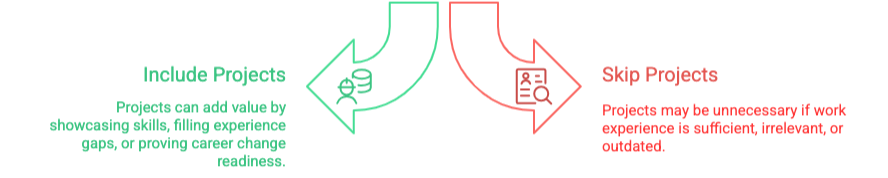
Not every project belongs on your resume. The decision depends on your experience level, the role you’re targeting, and whether projects add value beyond your work experience.
Include Projects When:
You’re changing careers: Projects in your target field prove you have practical skills, not just theoretical knowledge. A marketing professional transitioning to data analytics should highlight data projects, even if unpaid.
You have limited work experience: Academic projects, internships, and volunteer work demonstrate capabilities when your employment history is thin.
Projects showcase technical skills: Developers, designers, data scientists, and other technical professionals need tangible proof of what they can build.
You’re freelancing or consulting: Projects replace traditional employment history and show the breadth of your client work.
You have employment gaps: Personal projects, freelance work, or skill-building initiatives show you stayed current during time away from traditional employment.
Skip Projects When:
Your work experience is sufficient: Senior professionals with 15+ years of relevant experience don’t need to list college projects. Your employment history speaks for itself.
Projects aren’t relevant to the target role: That photography side hustle doesn’t strengthen your application for a financial analyst position unless you can connect it to relevant skills.
Projects are outdated: A website you built in 2010 using obsolete technology doesn’t demonstrate current capabilities.
You’re stretching to fill space: Listing every minor task as a “project” dilutes the impact of genuinely significant work.
Where to Place Projects on Your Resume
The placement of your projects section depends on how central projects are to your value proposition. There’s no universal “correct” location. Context determines the best structure.
Option 1: Dedicated “Projects” Section
Best for: Freelancers, career switchers, recent graduates, and technical professionals where projects are primary evidence of skills.
Placement: After your resume summary and before or after work experience, depending on which is stronger.
When to use this structure:
Option 2: Integrated Within Work Experience
Best for: Mid to senior-level professionals where projects occurred within employment.
Placement: As bullet points under the relevant employer in your work experience section.
When to use this structure:
Option 3: Combined “Projects & Freelance Work” Section
Best for: Professionals with a mix of traditional employment and independent project work.
Placement: After work experience or as a separate section if freelance work is substantial.
When to use this structure:
Option 4: Within Education Section
Best for: Recent graduates and students where projects were part of academic work.
Placement: Under the relevant degree in your education section.
When to use this structure:
How to Format Your Projects Section
Structure matters. A well-formatted projects section follows the same principles as effective work experience: clear context, specific actions, and quantifiable results.
Basic Project Entry Structure:
Project Title | Context/Platform | Date Brief description of what you built/accomplished (1 sentence)
Essential Elements to Include:
| Element | Purpose | Example |
|---|---|---|
| Project Name | Clear identifier | “E-commerce Analytics Dashboard” |
| Context | Where/why it happened | “Freelance Client Project” or “Personal Initiative” |
| Timeline | Shows recency | “Jan 2024 – Mar 2024” or “2024” |
| Technologies/ Tools | Demonstrates technical skills | “Python, SQL, Tableau” |
| Quantifiable Results | Proves impact | “Reduced reporting time by 40%” |
| Link (when applicable) | Provides evidence | GitHub repo, live site, portfolio |
Action Verbs That Strengthen Project Descriptions:
For technical projects: Developed, Built, Engineered, Designed, Implemented, Architected, Deployed, Optimized
For analytical projects: Analyzed, Evaluated, Researched, Investigated, Identified, Assessed, Measured
For creative projects: Created, Designed, Produced, Launched, Conceptualized, Illustrated
For management projects: Led, Coordinated, Managed, Organized, Facilitated, Directed, Oversaw
Resume Projects Section Examples by Role
Example 1: Software Developer (Career Switcher)
PROJECTS
Task Management SaaS Application | 2025
React, Node.js, PostgreSQL, AWS | github.com/username/project
- Built full-stack web application enabling teams to track project milestones, serving 200+ beta users
- Implemented RESTful API with JWT authentication, reducing unauthorized access attempts by 99%
- Optimized database queries, improving page load time by 60% compared to initial deployment
Open Source Contribution: React Component Library | 2024 – Present
React, TypeScript, Storybook
- Contributed 12 accessible UI components to library with 5,000+ weekly downloads
- Improved component test coverage from 60% to 95%, reducing production bugs by 40%
- Collaborated with 8 international developers through code reviews and documentation updates
Why this works: Each project includes specific technologies (matching job description keywords), quantifiable outcomes, and links to verifiable work. The projects demonstrate full-stack capabilities and collaborative skills which is exactly what employers want to see.
Example 2: Data Analyst (Recent Graduate)
PROJECTS & FREELANCE WORK
Customer Churn Prediction Model | Spring 2025
Python, Scikit-learn, Pandas | Capstone Project
- Analyzed 50,000+ customer records to identify churn patterns using logistic regression and random forest models
- Achieved 84% prediction accuracy, enabling proactive retention strategies for high-risk segments
- Presented findings to faculty panel and local business partners, receiving top project honors
Sales Performance Dashboard | Fall 2024
Tableau, SQL | Freelance Project
- Designed interactive dashboard tracking KPIs across 4 product lines for local retail client
- Automated weekly reporting process, reducing manual data compilation time from 6 hours to 15 minutes
- Identified underperforming product category, leading to inventory adjustment that improved margins by 12%
Why this works: Combines academic and freelance projects to show both theoretical knowledge and practical application. Metrics demonstrate real business impact, not just technical execution.
Example 3: Marketing Professional (Career Switcher to Product Management)
SELECT CLIENT PROJECTS
Mobile App Feature Launch: In-App Messaging | Jan – Jun 2025
Cross-Functional Initiative | Current Employer
- Led discovery phase with 30+ user interviews to identify communication pain points in existing app
- Coordinated 6-person team (design, engineering, QA) through 4-month development cycle
- Launched feature to 10,000 users, achieving 45% adoption rate within first month and 4.2/5 satisfaction score
Customer Onboarding Redesign | 2024
Process Improvement Project | Current Employer
- Analyzed user behavior data from 5,000+ new customers to identify drop-off points in onboarding flow
- Redesigned 7-step process into 3-step flow, reducing time-to-activation from 8 days to 2 days
- Increased trial-to-paid conversion rate by 28% within first quarter post-launch
Why this works: Frames marketing projects through a product management lens as user research, cross-functional leadership, and data-driven decision making. Shows transferable skills without forcing the narrative.
Example 4: Freelance Graphic Designer
PROJECTS
Brand Identity System | Tech Startup | 2025
Adobe Creative Suite, Figma | portfolio.com/project
- Developed complete brand identity including logo, color system, and typography for Series A SaaS company
- Created 40+ page brand guidelines ensuring consistency across digital and print applications
- Designed assets used in pitch deck that secured $3M in funding
E-commerce Website Redesign | Retail Client | 2024
Figma, Adobe XD | 8-week project
- Redesigned 25-page e-commerce site to improve mobile experience and conversion rates
- Conducted A/B testing on 3 checkout flow variations, identifying design that increased completions by 35%
- Delivered responsive designs optimized for 5 device breakpoints, reducing mobile bounce rate by 22%
Why this works: Treats freelance projects as professional work experience (which they are). Includes client context, business outcomes, and links to portfolio evidence.
For a complete overview of resume structure, see our guide on essential resume sections.
How to Quantify Project Achievements
Numbers transform vague descriptions into compelling evidence. But not every project has obvious metrics. Here’s how to quantify achievements even when data isn’t immediately apparent.
Direct Metrics (Preferred):
Indirect Metrics (When Direct Data Isn’t Available):
Framework for Finding Your Numbers:
Ask yourself these questions about each project:
If you genuinely can’t quantify, describe the technical complexity or business context instead: “Built recommendation engine processing user behavior across 12 product categories” is stronger than “Built recommendation engine.”
Common Mistakes When Listing Projects
Mistake 1: Listing Every Project You’ve Ever Done
The problem: A laundry list of minor projects dilutes the impact of your strongest work. Recruiters spend 7 seconds scanning resumes. They won’t read 10 project descriptions.
The fix: Curate ruthlessly. Include 2-4 highly relevant projects that directly align with the job description. Quality beats quantity.
Mistake 2: Vague Descriptions Without Context
The problem: “Created a website” tells recruiters nothing about complexity, purpose, or impact.
The fix: Provide context in every description. Who was it for? What problem did it solve? What technologies did you use? What was the outcome?
Weak: “Built mobile app” Strong: “Built iOS fitness tracking app for 200+ beta users, integrating HealthKit API and achieving 4.5-star rating”
Mistake 3: Ignoring ATS Optimization
The problem: Your projects section might showcase impressive work, but if it doesn’t include keywords from the job description, it won’t get past ATS filters.
The fix: Mirror language from the target role. If the job description mentions “Python,” “data visualization,” and “stakeholder presentations,” ensure your project descriptions include those exact terms where truthful.
AI resume optimization platforms like Upplai can analyze your projects section against specific job descriptions, identifying missing keywords and suggesting natural ways to incorporate them without keyword stuffing.
Mistake 4: No Links to Actual Work
The problem: For technical roles, claiming you built something without providing evidence raises skepticism.
The fix: Include links to GitHub repositories, live sites, online portfolios, or case studies whenever possible. If the project is confidential, describe it in sufficient technical detail to demonstrate expertise.
Mistake 5: Outdated or Irrelevant Projects
The problem: That Java applet from 2008 or unrelated hobby project wastes valuable resume space.
The fix: Projects should be recent (within 3-5 years for most roles) and relevant to your target position. If you’re applying for data science roles, your graphic design side hustle probably doesn’t belong, unless you can connect it to relevant skills like data visualization.
Tailoring Projects to Specific Job Descriptions
Generic projects sections don’t land interviews. The most effective resumes tailor project descriptions to match what each employer is actually looking for.
The Tailoring Process:
Step 1: Analyze the job description Identify the top 5-7 required skills and experiences. Note the exact language used. If they say “cross-functional collaboration,” use that phrase, not “teamwork.”
Step 2: Select relevant projects Choose projects that demonstrate those specific requirements. You might highlight different projects for different applications.
Step 3: Rewrite descriptions to emphasize relevant aspects The same project can be framed differently depending on what the role prioritizes. A web development project might emphasize front-end skills for one role and database optimization for another.
Step 4: Incorporate job-specific keywords Naturally weave in terminology from the job description. If they mention “agile methodology,” and you used it, say so explicitly.
Example: Same Project, Two Different Roles
For Product Manager Role:
E-commerce Platform Redesign | 2024
Led 5-person team through 3-month redesign of checkout flow, conducting user research with 50+ customers to identify pain points. Prioritized features using RICE framework, resulting in 28% increase in conversion rate and 40% reduction in cart abandonment.
For UX Designer Role:
E-commerce Platform Redesign | 2024
Designed end-to-end checkout experience based on usability testing with 50+ users. Created wireframes, prototypes, and high-fidelity mockups in Figma, iterating through 4 design versions. Final design increased conversion rate by 28% and received 4.6/5 user satisfaction score.
Same project, different emphasis based on what each role values.
Time Saving Tip
Tailoring your resume for each job can easily take 40-60 minutes per application. When you’re applying to dozens of roles, that’s unsustainable. Resume optimization platforms like Upplai analyze job descriptions and suggest how to reframe your project descriptions to match what specific employers are looking for, while keeping your content truthful and authentic.
Quick Checklist: Projects Section That Gets Interviews
Use this checklist before submitting your resume: