

TLDR:
- Include coursework only if you have limited work experience (recent graduate or student), are changing careers, or possess highly specialized skills not evident from work history; skip if you have 3+ years of relevant experience
- Place coursework within your Education section (for recent graduates), create a separate “Relevant Coursework” section (for career changers with significant recent education), or integrate into your Skills section (for technical roles)
- Limit to 6-8 most relevant courses, use descriptive course names (not course numbers), and separate with commas or bullets consistently
- Include only courses that match job description keywords: technical skills courses, specialized knowledge areas, advanced or graduate-level courses, and project-based courses; skip general education requirements and outdated technology courses
You’re staring at your resume, wondering if that Advanced Data Structures class or Digital Marketing Strategy course deserves a spot. Should you list coursework on your resume? And if so, how do you do it without looking like you’re padding a thin work history? This decision matters more than ever: according to the Cengage Group Graduate Employability Report, 48% of recent graduates feel unprepared to apply for entry-level positions, with 56% citing job-specific skills as their biggest gap. Strategic coursework listings can bridge that gap.
When Should You Include Relevant Coursework on Your Resume?
Not every resume needs a coursework section. The decision depends on where you are in your career and what you’re trying to prove.
Include coursework when you:
Skip coursework when you:
The rule of thumb: coursework should support your narrative, not replace actual accomplishments.
Where to Add Coursework to Your Resume
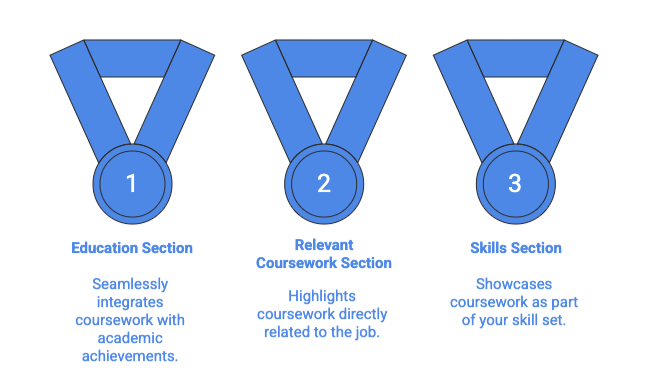
The placement of your coursework section matters. Put it in the wrong spot, and recruiters might miss it entirely or worse, think you’re inexperienced.
Option 1: Within Your Education Section
This is the most common and cleanest approach, especially for recent graduates. Your resume education section already exists, so adding coursework there keeps related information together.
When to use this placement:
Example format:
Bachelor of Science in Computer Science
University of California, Berkeley | May 2025
GPA: 3.7/4.0
Relevant Coursework: Machine Learning, Natural Language Processing, Database Systems, Advanced Algorithms, Software Engineering, Cloud Computing
Option 2: Separate “Relevant Coursework” Section
Create a standalone section when your coursework is substantial enough to warrant its own space and you want to draw attention to specific skills and knowledge.
When to use this placement:
Example format:
Relevant Coursework & Certifications
Data Science Specialization – Johns Hopkins University (Coursera)
- R Programming, Statistical Inference, Regression Models
- Practical Machine Learning, Data Products Development
MBA Coursework – Northwestern University (In Progress)
- Financial Accounting, Corporate Finance, Marketing Strategy
- Operations Management, Business Analytics
Option 3: Integrated Into Your Skills Section
For technical roles, you can weave coursework into your skills section to provide context for how you acquired specific competencies.
When to use this placement:
Example format:
Technical SKILLS
Programming Languages: Python, Java, SQL, R (Advanced Coursework: Data Structures, Algorithms, Database Design)
Data Analysis: Pandas, NumPy, Scikit-learn, TensorFlow (Coursework: Machine Learning, Statistical Analysis, Data Visualization)
Cloud Platforms: AWS, Azure (Coursework: Cloud Architecture, Distributed Systems)
The placement you choose should make your resume easier to scan, not harder. If recruiters need to hunt for relevant information, you’ve already lost.
How to Format Coursework on Your Resume
Format matters because Applicant Tracking Systems parse your resume differently depending on how you structure information. A poorly formatted coursework section might not get indexed properly, meaning those keywords won’t count toward your ATS score.
Basic Formatting Rules
Use consistent punctuation: Choose either commas or bullets to separate courses, then stick with it throughout your resume.
Keep course names clear: Use the official course title if it’s self-explanatory (“Financial Accounting” is better than “ACCT 301”). If the official name is vague, use a descriptive version (“Mobile App Development” instead of “Advanced Topics in CS”).
Limit to 6-8 courses maximum: More than that and you’re wasting valuable resume real estate. Choose the courses most relevant to your target role.
Group related courses: If you’re listing multiple courses, cluster them by theme (e.g., “Data Analysis: Statistics, Data Mining, Predictive Modeling”).
Format Examples
Comma-separated (most common):
Relevant Coursework: Financial Modeling, Corporate Finance, Investment Analysis, Portfolio Management, Risk Management, Derivatives
Bulleted list (for emphasis):
Relevant Coursework:
- Advanced Machine Learning & Neural Networks
- Natural Language Processing & Text Mining
- Computer Vision & Image Recognition
- Big Data Analytics & Distributed Computing
Grouped by category (for technical roles):
Technical Coursework:
- Programming: Data Structures, Algorithms, Software Engineering
- Data Science: Machine Learning, Statistical Analysis, Data Visualization
- Systems: Database Design, Cloud Computing, Distributed Systems
With descriptions (when space allows):
Relevant Coursework:
- Digital Marketing Strategy – Developed integrated campaigns across SEO, SEM, social media, and email channels
- Marketing Analytics – Applied statistical methods to customer data using Python and Tableau
- Consumer Behavior – Analyzed psychological factors influencing purchase decisions
The format you choose should match your resume’s overall style. If your work experience uses bullets, your coursework should too. Consistency signals attention to detail.
What Coursework to Include (And What to Skip)
Not all courses are created equal in the eyes of recruiters. The key is selectivity. So, list only coursework that directly demonstrates skills mentioned in the job description or fills a gap in your work experience.
Include These Types of Courses
✅ Technical skills courses: Any class that taught you a specific tool, programming language, or methodology mentioned in job postings. Examples: Python Programming, SQL Database Management, AutoCAD, Adobe Creative Suite.
✅ Specialized knowledge areas: Courses that demonstrate expertise in your target industry. For finance roles: Derivatives, Risk Management, Financial Modeling. For marketing: Consumer Behavior, Marketing Analytics, Brand Strategy.
✅ Advanced or graduate-level courses: These signal deeper knowledge than typical undergraduate requirements. “Advanced Statistical Methods” carries more weight than “Introduction to Statistics.”
✅ Project-based courses: Classes where you built something tangible. “Mobile App Development (Built iOS fitness tracking app)” is more impressive than “Introduction to Mobile Computing.”
✅ Certifications and professional courses: Industry-recognized programs like CFA coursework, PMP certification prep, or specialized bootcamps.
Skip These Types of Courses
❌ General education requirements: Nobody cares that you took English Composition, College Algebra, or Introduction to Psychology (unless you’re applying for psychology roles).
❌ Obvious courses for your major: If you have a Computer Science degree, listing “Introduction to Programming” is redundant. Recruiters assume you covered the basics.
❌ Outdated technology courses: That 2012 Flash Animation class isn’t helping your web development application in 2024.
❌ Courses unrelated to your target role: Your Philosophy of Ethics course might have been fascinating, but it doesn’t belong on your software engineering resume.
❌ Low-level courses when you have advanced ones: If you’re listing “Advanced Corporate Finance,” don’t also list “Introduction to Finance.”
Matching Coursework to Job Description Keywords
Here’s where listing coursework on resume strategy intersects with ATS optimization. Applicant Tracking Systems scan for specific keywords from the job description. If the posting mentions “experience with regression analysis” and you took a Statistics course covering regression, that’s a keyword match.
Example job description excerpt: “Seeking data analyst with experience in SQL, Python, statistical analysis, and data visualization tools like Tableau.”
Relevant coursework to include:
Notice how each course maps to a required skill. This isn’t about gaming the system and more about clearly communicating that you have the foundational knowledge the role requires.
Relevant Coursework Examples by Career Stage
The way you present coursework should evolve as your career progresses. Here’s how different job seekers should approach this resume section.
Recent Graduate Example
When you have minimal work experience, coursework demonstrates your capabilities and helps you get past ATS filters.
Bachelor of Science in Marketing
University of Michigan | May 2025 | GPA: 3.6/4.0
Relevant Coursework:
- Digital Marketing Strategy – Developed SEO/SEM campaigns with 40% engagement increase
- Marketing Analytics – Analyzed customer datasets using Python and Tableau
- Consumer Behavior & Market Research
- Social Media Marketing – Managed live campaigns for local businesses
- Brand Management & Integrated Marketing Communications
Why this works: The coursework includes specific tools (Python, Tableau) and quantifiable outcomes from class projects, making it more than just a list of class names.
Career Changer Example
When transitioning industries, coursework proves you’ve invested in developing new skills and knowledge.
Professional Development
Data Science Certificate | General Assembly | 2024
Technical Coursework: Python Programming, Statistical Analysis, Machine Learning, SQL & Database Design, Data Visualization with Tableau
Capstone Project: Built predictive model for customer churn using scikit-learn, achieving 87% accuracy on test data
Additional Training:
- AWS Certified Cloud Practitioner (In Progress)
- Advanced Excel & Business Analytics – Coursera
Why this works: It positions recent education prominently, includes a concrete project outcome, and shows continued learning through additional certifications.
Current Student Example (Internship Applications)
When you’re still in school, coursework is often your strongest selling point for entry-level jobs and internships.
Education
Bachelor of Science in Computer Science (Expected May 2026)
Georgia Institute of Technology | Current GPA: 3.8/4.0
Relevant Technical Coursework:
- Data Structures & Algorithms (A), Object-Oriented Programming (A)
- Database Systems, Web Development, Software Engineering
- Currently enrolled: Machine Learning, Cloud Computing, Cybersecurity
Key Projects: E-commerce web app with React/Node.js, Recommendation system using collaborative filtering
Why this works: Including grades for key courses (when strong) adds credibility. Mentioning current enrollment shows forward momentum. The projects section gives concrete evidence of applied skills.
Mid-Career Professional with Recent Certification
When you have solid work experience but recently completed relevant coursework, integrate it strategically without overshadowing your achievements.
Education & Certifications
Georgia Institute of Technology | Current GPA: 3.8/4.0
Project Management Professional (PMP) | Project Management Institute | 2024
Coursework: Agile Methodologies, Risk Management, Stakeholder Communication, Project Scheduling & Budgeting
MBA, Finance Concentration | Northwestern University (Kellogg) | 2018
Bachelor of Science in Engineering | Purdue University | 2014
Why this works: Recent, relevant certification appears first. Coursework is brief since work experience carries more weight. Earlier degrees are listed without coursework details.
Common Mistakes When Adding Coursework to Your Resume
Even when coursework is relevant, poor execution can undermine your resume’s effectiveness. Here are the mistakes that make recruiters skip over your education section.
Mistake 1: Listing Too Many Courses
The problem: A wall of 15 course names looks desperate and makes it harder to identify what actually matters.
The fix: Limit yourself to 6-8 highly relevant courses. Quality over quantity. If you can’t explain why a course matters to the target role, cut it.
Mistake 2: Using Course Numbers Instead of Names
The problem: “ECON 301, ECON 412, ECON 450” means nothing to recruiters or ATS systems.
The fix: Use descriptive course names: “Econometrics, International Trade, Monetary Policy.” If the official name is unclear, translate it into plain language.
Mistake 3: Including Coursework When You Have Sufficient Work Experience
The problem: A senior data scientist with 8 years of experience listing “Introduction to Python” looks amateurish.
The fix: Once you have 3+ years of relevant work experience, let your job history/work experience speak for itself. The exception: recent specialized certifications or graduate coursework in a new area.
Mistake 4: Failing to Connect Coursework to Job Requirements
The problem: Listing random courses without considering what the job description actually requires.
The fix: Read the job posting carefully. Identify required skills and knowledge. Only include coursework that demonstrates those specific capabilities. If the job emphasizes “data visualization,” make sure your Data Visualization course is listed.
Mistake 5: Poor Formatting That Breaks ATS Parsing
The problem: Using tables, text boxes, or unusual formatting that Applicant Tracking Systems can’t read properly.
The fix: Stick to simple formatting, which is standard fonts, clear section headers, and basic bullets or commas. Test your resume through an ATS checker to ensure coursework is being parsed correctly.
Mistake 6: Not Providing Context for Projects or Outcomes
The problem: “Machine Learning” as a line item doesn’t differentiate you from thousands of other candidates who took the same course.
The fix: When space allows, add brief context: “Machine Learning – Built recommendation engine using collaborative filtering, deployed on AWS.” This transforms a course listing into evidence of applied skills.
Optimizing Your Coursework Section for ATS
Applicant Tracking Systems scan resumes for keywords and parse them into structured data. If your coursework section isn’t ATS-friendly, those carefully chosen courses might not register at all.
ATS-Friendly Formatting Guidelines
Use standard section headers: “Education,” “Relevant Coursework,” or “Certifications” are universally recognized. Avoid creative headers like “Academic Journey” or “Learning Path.”
Keep formatting simple: Standard bullet points and commas work. Avoid tables, columns, text boxes, or graphics that ATS software can’t parse.
Spell out acronyms on first use: “Natural Language Processing (NLP)” ensures the system captures both the full term and the abbreviation.
Use keywords from the job description: If the posting mentions “financial modeling,” use that exact phrase in your coursework rather than “advanced finance techniques.”
Place coursework in a logical location: Within your Education section or as a standalone section near the top of your resume. Burying it at the bottom reduces its keyword impact.
Keyword Optimization Strategy
The job description is your keyword map. Here’s how to extract and apply those keywords to your coursework section:
Example job description keywords:
Optimized coursework section:
Copied!Relevant Coursework: Python Programming, SQL & Database Design, Machine Learning Algorithms, Cloud Computing (AWS), Statistical Analysis & Regression Modeling
Notice how each course directly addresses a keyword from the job description. This isn’t manipulation; it’s clear communication that you have the foundational knowledge they’re seeking.
Real-time ATS scoring tools can show you exactly how well your coursework section is performing. As you add or remove courses, you can see your keyword match score change, helping you optimize for each specific job application.
Time Saving Tip
Adapting your resume for each opportunity often takes close to an hour per application. If you’re applying at scale, that approach simply isn’t practical. Resume optimization platforms such as Upplai break down job listings and guide you on how to adjust your project details to better reflect employer expectations, while staying honest and true to your experience.
Quick Checklist: Is Your Coursework Section Resume-Ready?
Use this checklist before submitting your resume to ensure your coursework section is working for you, not against you.
Relevance Check
Formatting Check
Keyword Optimization Check
Context Check
Career Stage Appropriateness
Final Quality Check
If you checked every box, your coursework section is ready. If not, revise before submitting.