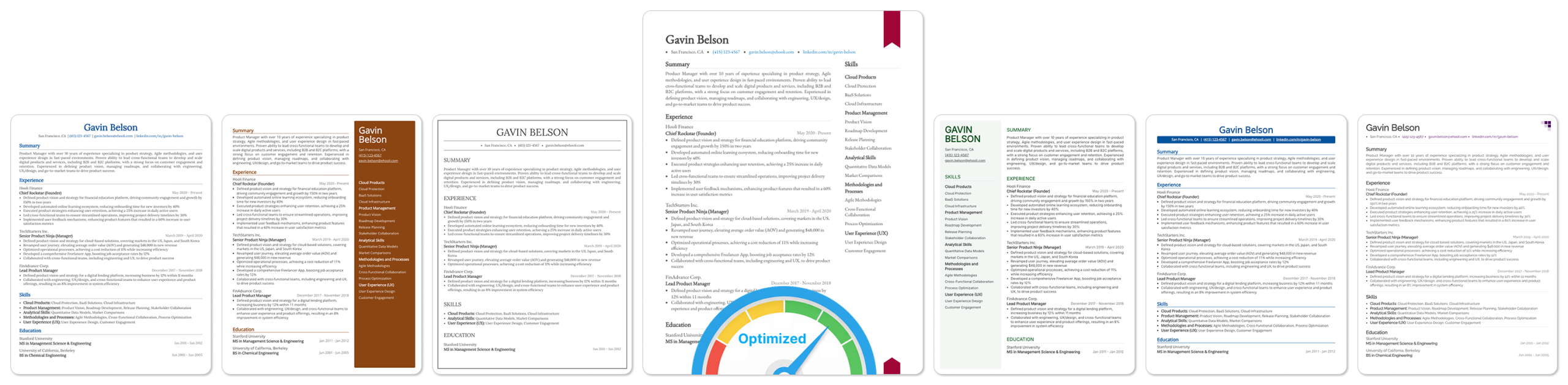



TLDR:
- List your most recent job first, then work backward. Include job title, company, location, dates (Month Year to Month Year), and 3-5 bullet points with measurable results.
- Use this format if you have consistent work history, are staying in your field, or applying online. It works with ATS systems and shows career growth quickly.
- Structure: Header (name, contact) → Summary (2-3 sentences, optional) → Work Experience (newest first) → Education (highest degree first) → Skills → Optional sections (certifications, languages).
- Keep formatting simple: single column, standard fonts (Arial or Calibri, 10-12pt), no graphics or tables, save as .docx or PDF.
The format of your resume often matters more than the content on it. Recruiters spend just a few seconds scanning a resume on the first pass. If they cannot find what they are looking for in that window, they move on.
That’s where the reverse chronological resume format comes in. It puts your strongest, most recent experience exactly where it needs to be.
With that in mind, in this guide, we cover everything about the reverse chronological resume format: how the format works, when to use it, and how to build one that actually gets past both ATS filters and recruiter scrutiny.
What is a Reverse Chronological Resume?
A reverse chronological resume is a resume format that highlights your most recent experience first. Instead of starting with your earliest job, it begins with your current or latest role and then moves backward through your work history.
A typical reverse chronological resume includes these sections:
Here is the example template:
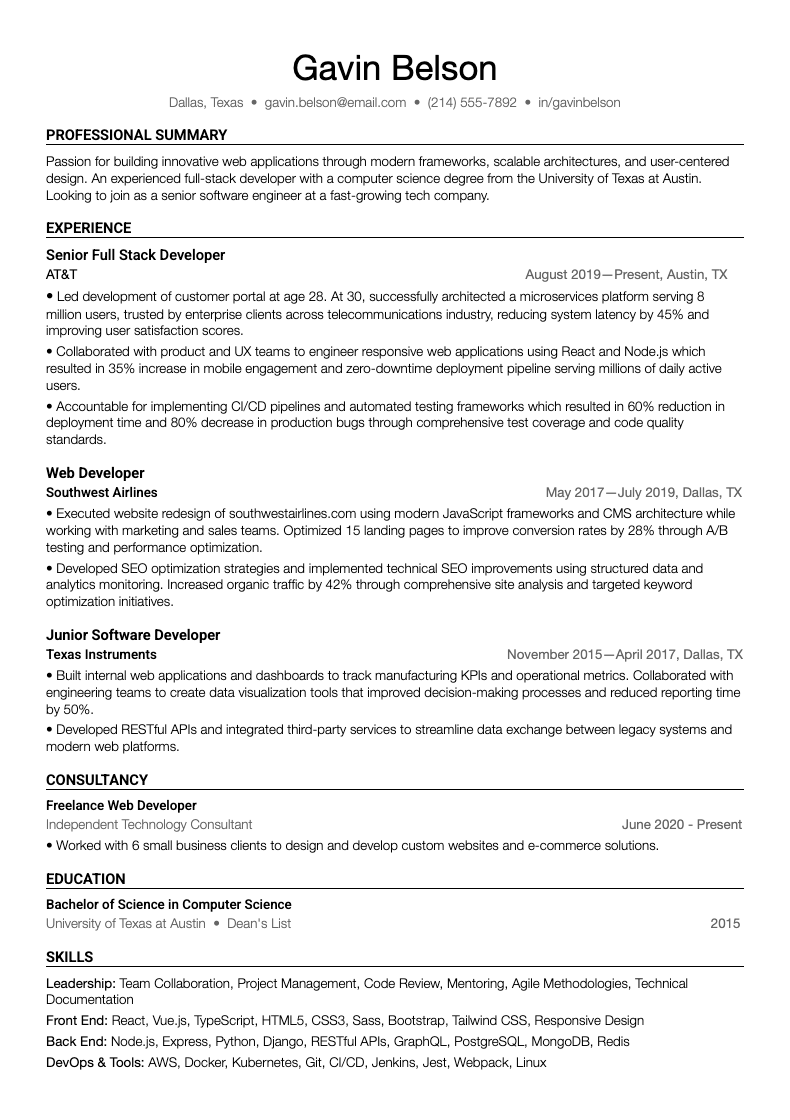
The difference between a reverse chronological resume format and a standard chronological resume is direction.
A chronological resume starts with your oldest job and moves forward in time. On the other hand, the reverse chronological version leads with what you are doing right now. Recruiters usually prefer a reverse chronological resume because they always want to know your most recent work experience, before anything else.
Why Should Resumes Be in Reverse Chronological Order?
The reverse chronological format has become the professional standard across industries for practical, well-established reasons. Here are 4 reasons why recruiters prefer it.
It Highlights Your Current Value
Your most recent position reflects your current skill level, scope of responsibility, and professional standing. When your latest experience is the first thing a hiring manager sees, they can assess your fit immediately without digging through older, less relevant roles.
This matters especially when you are applying for something similar to your current position, because your strongest qualifications land right at the top.
It Tells a Story of Growth
Career progression is something hiring managers actively look for. Reading from your current role downward, a recruiter can trace the full arc of your professional development. This includes promotions, expanding responsibilities, and deliberate moves that built your skill set over time.
When your work history shows a clear pattern of growth, it communicates that you are both ambitious and consistent.
It Makes Your Resume Scannable
Recruiters do not read resumes line by line on a first pass. They scan for signals that someone is worth a closer look.
If you are using a reverse chronological resume, your most recent job title, employer, and dates sit at the top, right where recruiters will look first. Recruiters can just scan to confirm if you have relevant recent experience within seconds and decide whether to keep reading.
It is ATS-Friendly
Nowadays, a lot of resumes are filtered out by ATS (Applicant Tracking System) before a human ever reads them. The reverse chronological format is one of the safest choices for getting past these systems.
Standard section headers and consistent date formatting help ATS software correctly parse your resume. With a clear timeline in place, the system can more reliably identify your roles and match your background against job requirements.
Alternative formats like functional resumes can cause problems because they don’t follow a clear timeline, which may cause your application to be filtered out before any recruiter sees it.
Time Saving Tip
Instead of spending hours tailoring your resume to every job application, you can use an AI resume tool like Upplai. It analyzes your resume against the job description in real time, shows you your ATS score as you edit, and tells you exactly where you stand before you hit submit.
How to Make a Reverse Chronological Resume
Here’s how you can make a reverse chronological resume in 7 steps:
Step 1: Start With a Clear Header
Your header section is the first thing a recruiter sees, so keep it clean and professional. For starters, you can include the following information:
If you are applying to a US or a European company, you should leave out your photo. That’s because it is not standard practice there and can introduce unconscious bias into the screening process.
Example:

Pro Tip: Make sure the name on your resume matches your LinkedIn profile and also the file name of your email attachment. It makes it easier for recruiters to connect everything.
Step 2: Write a Professional Summary
A three to four sentence summary at the top of your resume acts as your elevator pitch — it sets the context for the recruiter before they even reach your work history. It is especially useful for senior professionals, career changers, or anyone with a complex background. If you are early in your career, a resume objective may be more appropriate.
A strong summary includes:
If you are a recent grad or early in your career, a resume objective may be more appropriate than a summary. For those unfamiliar with the difference: a summary focuses on what you bring to the role, while an objective focuses on your goals and what you aim to contribute.
Tip: When writing the summary (or objective) use keywords from the job description to optimize for ATS.
Example:
Copied!Senior Product Manager with 8+ years driving enterprise SaaS solutions from concept to launch. Led cross-functional teams that delivered products generating $50M in annual revenue. Expertise in agile development, user research, and data-driven roadmap prioritization.
Step 3: Build Your Work Experience Section
The work experience section is the core of your resume. You should label it as “Work Experience” or “Professional Experience” instead of something creative or fancy so that the recruiters can find it easily.
Then, list roles starting with your most recent work experience. While listing the work experiences, include your job title, company name with city and state, and employment dates in Month-Year format for each position.
You can also add a brief one-line company description if the organization is not widely known.
Under each role, write bullet points that describe what you actually achieved, not just what your job required. Doing this will separate you from most other candidates.
Use a simple formula: Action Verb + Task + Result + Metric.
Aim for 4 to 5 bullets in your most recent role and 2 to 3 in older ones. That’s because your recent work experience carries more weight and should be prioritized.
Example:
EXPERIENCE
Chief Marketing Officer
Cloud Tech Solutions | Seattle, WA | March 2023 – Present
- Architect and execute comprehensive marketing strategies for $500M B2B technology company, driving 60% revenue growth over 4 years and expanding into 12 new international markets
- Build and lead global marketing organization of 85+ professionals across Brand, Demand Generation, Product Marketing, Communications, and Marketing Operations functions
- Spearhead digital transformation initiative that modernized the marketing technology stack, implementing AI-powered tools that increased marketing efficiency by 45% and reduced customer acquisition costs by 35%
- Partner with CEO and Board of Directors to develop corporate positioning and messaging for successful Series D funding round raising $150M
- Establish data-driven marketing culture by implementing advanced analytics and attribution modeling, enabling real-time optimization that improved marketing ROI from 3:1 to 7:1
- Direct rebranding initiative that elevated market perception, resulting in 50-point increase in brand awareness and recognition as industry leader by Forrester and Gartner
- Cultivate strategic partnerships with Fortune 500 companies, generating $75M in co-marketing driven revenue
Step 4: List Your Education in Reverse Chronological Order
The education section follows the same rule as the work experience section. Start with the most recent or highest degree first. Include the degree type and major, institution name, location, and graduation year.
A few practical notes to keep in mind:
Example:
Master of Science in Engineering Management | Stanford University | 2026
Bachelor of Science in Electrical Engineering| MIT | 2024
Step 5: Add a Skills Section
When working on the skills section, list the hard skills most relevant to your target role and group them by category where it makes sense. To make the resume more ATS-friendly, don’t forget to use keywords directly from the job description.
Only keep it to 5 to 10 hard skills that are relevant to the job and/or mentioned in the job description. Also, leave soft skills like communication or leadership out entirely. These should be demonstrated through achievements in your work experience section.
Step 6: Add Optional Sections Where Relevant
Depending on your industry and the specific role, a few additional sections can add genuine value. Only include them if you have real content to fill them.
| Section | Best For | What to Include |
|---|---|---|
| Certifications on a Resume | Tech, healthcare, finance, project management | Credential name, issuing organization, year earned |
| Languages on a Resume | Roles with international or multilingual scope | Language and proficiency level (e.g., Fluent, Conversational) |
| Publications and Research | Academic, scientific, or thought leadership roles | Title, publication, year |
| Volunteer Work | Early career, career changers, mission-driven orgs | Role, org name, dates, 1 to 2 impact bullets |
| Professional Affiliations | Industry associations or licensing boards | Organization name and membership status |
Best Practices for Formatting Your Resume
Before you hit send, here are a few formatting rules worth getting right. They are easy to overlook but can make a real difference in how your resume is read, both by ATS systems and recruiters.
Reverse Chronological Resume Templates
Senior / Executive Resume Template

If you are a senior professional with 15 or more years of experience, the challenge is not having enough to say but knowing what to cut. This template shows how to lead with a strong summary, give your most recent role the most real estate, and scale back detail on older positions without losing the story of your growth.
Career Changer Resume Template

Switching industries does not mean starting from scratch. This template shows how to frame transferable skills and recent certifications within a reverse chronological structure, so your background reads as an asset rather than a question mark.
Recent Graduate Resume Template
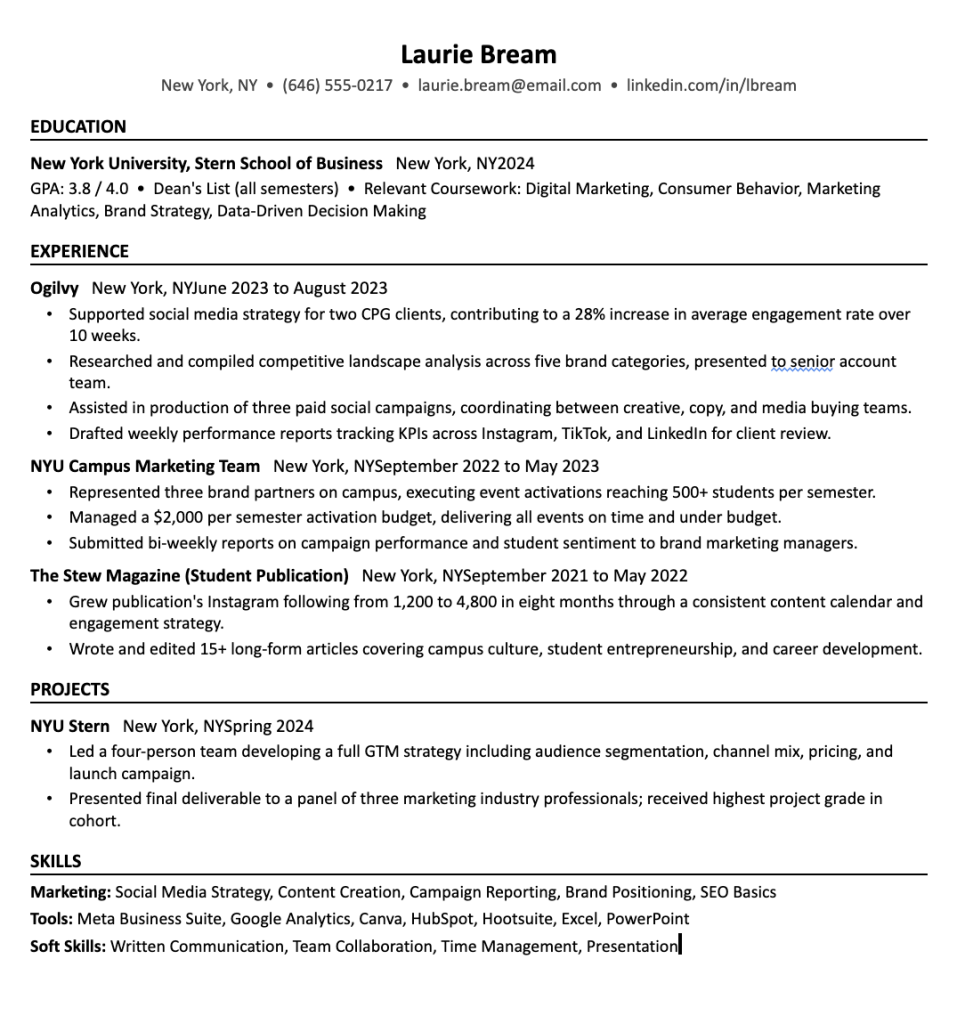
When you do not have much work history yet, structure matters even more. This template puts education first, makes the most of internships and campus experience, and shows how to present a lean resume confidently without padding it out.
When Should You Use a Reverse Chronological Resume?
The reverse chronological format works for the vast majority of job seekers in the US. Here are five situations where it is especially the right call.
1. You Have a Consistent Work History
When you have a steady work history without long breaks, it shows that you are a reliable professional. A reverse chronological resume tells this story clearly, so you do not need to explain it. When a hiring manager reads your resume from top to bottom, they see a consistent record of employment.
2. You Are Staying in the Same Industry
If you are applying for a job in the same field you have been working in, this format works really well. Recruiters in your industry already know the companies you have worked at and understand what your experience means. You do not need to over-explain anything, as your work history speaks for itself.
3. You Want to Show Promotion and Growth
If you have moved up in your career over time, this format makes that easy to see. A hiring manager can read through your roles from the most recent to the oldest and clearly see how you have grown. That kind of progression is something most employers look for.
4. You Are Applying to Traditional Organizations
Industries like finance, law, healthcare, and government tend to expect a standard resume format. Using something different can raise unnecessary questions before you even get to the interview. When you are applying to these kinds of organizations, it is better to stick with what they are used to seeing.
5. You Are Applying via Online Portals
Most people apply for jobs through platforms like LinkedIn, Indeed, or company websites. These platforms use ATS software to go through applications before a real person sees them. The reverse chronological format works well with these systems, so your resume is less likely to get filtered out.
When to Consider Alternative Formats
The reverse chronological format is the right starting point for most people, but it does not fit every situation. For example: