

TL;DR
Prompt engineering is one of the fastest-growing roles in tech, and the hiring bar is rising just as fast. A year ago, listing “ChatGPT” on a resume got attention. Today, recruiters want candidates who can design production-grade prompt pipelines, evaluate output quality systematically, and work across multiple model families and frameworks.
Most resume advice was not written for this role. But this guide on the prompt engineering resume is. In this guide, you will find concrete examples, section-by-section guidance, and specific advice on where prompt engineer resumes tend to go wrong.
What Makes a Prompt Engineer Resume Different From Other Tech Resumes
The difference between a prompt engineer resume and other tech resumes is that most tech resumes lean on GitHub repos, LeetCode scores, or system design experience.
However, as a prompt engineer, your edge is different. You’re working at the intersection of linguistics, model behavior, and product outcomes. Recruiters scanning your resume may not fully understand what prompt chaining, RAG pipelines, or few-shot tuning means, but they do understand results.
Your resume needs to show both the technical depth (which LLMs you’ve worked with, which frameworks) and the output (what actually got better because of your prompts). That dual framing is what separates a strong prompt engineer resume from a generic AI resume.
What Recruiters Look for in a Prompt Engineer Resume
Recruiters hiring for prompt engineering roles are often technical leads or AI product managers. They know enough to spot vague claims, but they also rely on your resume to translate your work into something their hiring pipeline can evaluate. Here’s what they’re actually scanning for.
Core Technical Competencies
You need to be explicit about the tools and techniques you’ve worked with. Recruiters want to see which LLMs you’ve actually deployed prompts against (GPT-5, Claude, Gemini, Mistral, Llama), which orchestration frameworks you’ve used (LangChain, LlamaIndex, Semantic Kernel), and whether you’ve worked with APIs directly or through abstraction layers.
Beyond tooling, they look for specific techniques: few-shot and zero-shot prompting, chain-of-thought reasoning, prompt chaining, RAG pipeline design, system prompt architecture, and output validation strategies.
Listing “prompt engineering” as a skill without any of this specificity reads as surface-level to a technical recruiter.
If you’ve done any fine-tuning, RLHF work, or evaluation framework design, include that too. These competencies push you into a higher tier of candidates.
AI/ML Domain Knowledge
You don’t need a machine learning PhD, but recruiters do expect you to understand how the models you’re prompting actually behave. This means familiarity with concepts like temperature and top-p sampling, context window constraints, tokenization, hallucination patterns, and model-specific quirks.
Why does this matter on a resume? Because it signals that your prompting decisions are grounded in model behavior, not trial and error. Recruiters want prompt engineers who can reason about why a prompt works and why it doesn’t.
If you have experience across multiple model families or have worked with multimodal inputs (vision, audio, structured data), call that out explicitly. Breadth of model exposure is increasingly valuable as teams move across providers.
Domain specialization also matters here. Prompt engineering for a customer support automation tool looks different from prompt engineering for a legal document analysis system. If your experience aligns with the industry the company operates in, make that visible.
Portfolio and Demonstrable Output
This is where many prompt engineer resumes fall short. Recruiters want to see evidence of your work, and prompts themselves are hard to showcase in a traditional resume format. The solution is to anchor your experience in outcomes.
On your resume, this means documenting what your prompts were designed to do and what measurably changed. Accuracy improvements on an evaluation set, reduction in hallucination rate, latency optimization through prompt compression, cost reduction through token efficiency, these are the kinds of outputs that translate well.
Beyond the resume itself, recruiters increasingly expect a portfolio link. This could be a GitHub repo with documented prompt libraries, a write-up on a Substack or personal site, or a published case study.
You don’t need all of these, but having at least one external reference gives recruiters something to dig into after your resume clears initial screening.
How to Write a Prompt Engineer Resume Step by Step
Here’s how you can write a resume for applying to a prompt engineering role in 5 steps:
Write a Targeted Summary or Objective
Your resume summary is the first thing a recruiter reads, and in a field as new as prompt engineering, it carries more weight than in most other tech roles. There’s no standardized career path here. So, your summary needs to quickly establish who you are, what you’ve worked on, and which slice of the prompt engineering space you belong to.
If you have experience, write a professional summary. Keep it to three or four sentences. Lead with your years of experience and the types of systems you’ve built prompts for. Follow with one or two specific technical strengths, then close with the domain or industry context you’ve worked in.
❌ A weak summary looks like this:
“Responsible for taking patient vital signs and updating medical records”
✅ A stronger one looks like this:
“Prompt engineer with 4 years of experience building LLM-powered pipelines for enterprise search and document intelligence applications. Proficient in RAG architecture, system prompt design, and evaluation framework development across GPT-5 and Claude model families. Previously reduced hallucination rates by 35% on a legal document extraction system through structured output prompting and iterative eval cycles.”
The difference is specificity. Domain, models, techniques, and a real output. All in three sentences.
If you are entry-level or transitioning from a related field like technical writing, NLP, linguistics, or software development, use an objective statement instead. Your goal here is to connect your existing background to prompt engineering credibly, without overstating your experience.
For example:
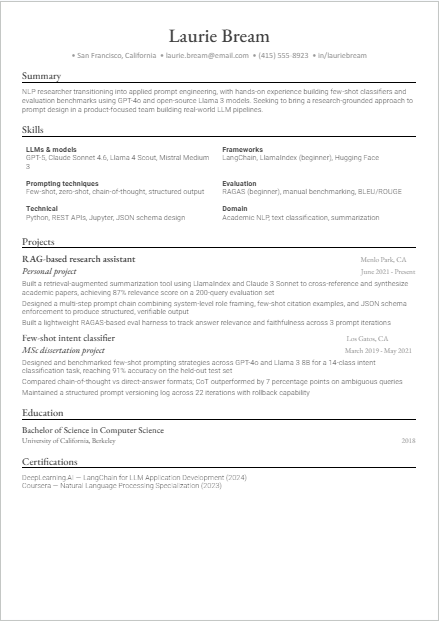
“NLP researcher transitioning into applied prompt engineering, with hands-on experience building few-shot classifiers and evaluation benchmarks using GPT-4 and open-source Llama models. Looking to bring a research-grounded approach to prompt design in a product-focused team.”
A few things to keep in mind, regardless of experience level–
Your summary is not a cover letter. Keep it tight, grounded in specifics, and directly relevant to the role you’re applying for.
Build a Skills Section That Speaks to Hiring Managers
The skills section on a prompt engineer resume is tricky because the field pulls from multiple disciplines at once. You need to organize your skills in a way that makes sense to both a technical recruiter and a hiring manager who may be less hands-on with AI tooling.
So, you need to structure your skills into clear categories. A flat list of 20 mixed skills is hard to scan. Group them instead:
- LLMs and Models: GPT-5, Claude 4, Gemini 3, Mistral, Llama 3, Cohere Command
- Frameworks and Orchestration: LangChain, LlamaIndex, Semantic Kernel, Haystack, AutoGen
- Prompting Techniques: Few-shot prompting, chain-of-thought reasoning, system prompt architecture, RAG pipeline design, prompt chaining, structured output prompting, adversarial prompt testing
- Evaluation and Testing: LLM evaluation frameworks, RAGAS, PromptFlow, hallucination benchmarking, A/B prompt testing, regression testing for prompt changes
- Supporting Technical Skills: Python, REST APIs, vector databases (Pinecone, Weaviate, Chroma), JSON schema design, token optimization
- Domain Knowledge (List this only if it’s genuinely relevant): Enterprise search, legal document processing, customer support automation, code generation, and similar domains are worth including if your experience aligns with the role.
A few things to get right here:
How to Frame Your Work Experience as a Prompt Engineer
Work experience is the hardest section to write for prompt engineers, for two reasons.
First, the job title itself is new, so many people doing prompt engineering work are carrying different titles: AI engineer, NLP engineer, ML engineer, conversational AI designer, or even product manager.
Second, the actual work is iterative and experimental in nature, which makes it hard to package into clean resume bullets.
Here is how to approach it—
❌ Instead of:
“Wrote and tested prompts for customer service chatbot”
✅ Try:
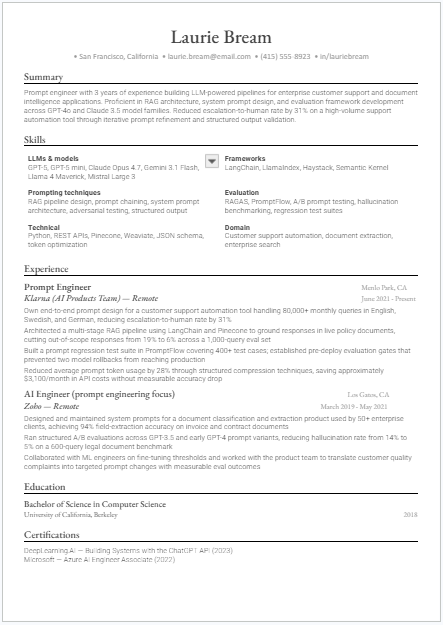
“Designed and iterated on system prompts and retrieval pipelines for a customer support automation tool handling 50,000+ monthly queries, reducing escalation to human agents by 28%.”
The second version tells the recruiter the scale of the system, the type of prompting work involved, and the measurable outcome.
What to do if your experience is mostly freelance or project-based
Treat each significant project as its own entry with a client descriptor, timeframe, and outcome-focused bullets. If you have several smaller engagements, group them under a consulting umbrella entry rather than listing each one separately and cluttering the section.
A rough structure for each role entry looks like this:
Prompt Engineer | Fintech Startup (Series B) | Remote | Jan 2023 – Present
Built and maintained the LLM pipeline powering an AI-assisted financial document review tool used by 200+ enterprise clients.
Quantify Your Impact With Metrics
Prompt engineering is still a field where many practitioners write experience bullets like “improved model outputs” or “optimized prompts for better performance.” That kind of language tells a recruiter nothing actionable. Metrics are how you separate yourself from the majority of candidates who are describing the same work in equally vague terms.
The challenge specific to prompt engineering is that not all impact is easy to measure, and some of it lives in evaluation frameworks that only your team understands. Here is how to think through quantification across different categories of work.
Accuracy and quality metrics:
Efficiency and cost metrics
Product and business metrics
Scale metrics
What to do when you don’t have clean numbers
Not every prompt engineering role produces tidy metrics. If your work was more research-oriented or your team didn’t instrument evaluations formally, you can still quantify scope.
You can answer questions like: How many prompts did you maintain? Across how many model versions? How large was the context window you were working within? How many stakeholders or downstream teams depended on your output?
Scope numbers are weaker than outcome numbers, but they are better than no numbers at all.
One practical approach: go back through Slack threads, Notion docs, or eval spreadsheets from past roles before writing your resume. Metrics you didn’t think to record formally often exist somewhere. A 15-minute search through old project notes frequently surfaces numbers you had forgotten about.
Finally, be accurate. Recruiter scrutiny in AI hiring is high right now, and inflated metrics get probed in interviews. If your number came from a limited eval set or a short time window, you can note that context briefly.
Honest, specific numbers with context are more credible than round, impressive-sounding ones without it.
How to Include Prompt Engineering Side Projects
Side projects carry real weight in prompt engineering hiring, more so than in many other tech roles. Because the field is new and formal experience is hard to come by, recruiters are accustomed to evaluating candidates whose strongest work happened outside a job title. A well-documented side project can outperform a vague professional bullet point.
Here’s how you can list your prompt engineering side projects professionally:
✅ For example,
“Built a RAG-based research assistant using LlamaIndex and Claude 4 Sonnet to summarize and cross-reference academic papers, achieving 87% relevance score on a 200-query evaluation set” is a project entry.”
❌ “Experimented with AI tools to build a chatbot” is not.
Always remember that one project done well beats five projects listed superficially.
Prompt Engineer Resume Examples
Entry-Level Prompt Engineer Resume
Mid-Level Prompt Engineer Resume
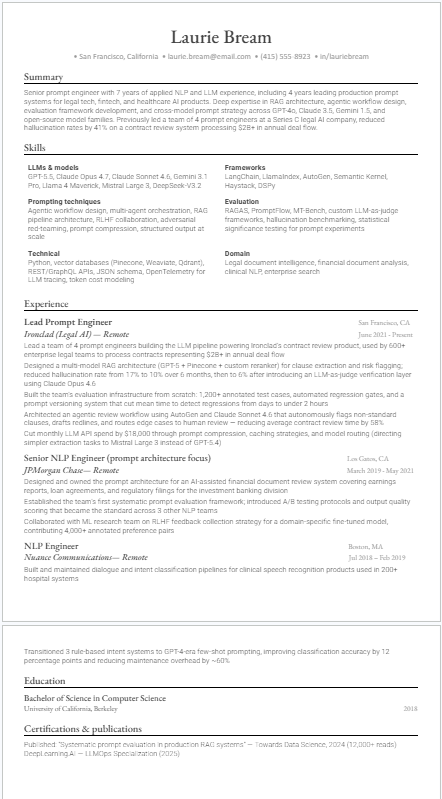
Senior Prompt Engineer Resume
What to Do If Your Previous Job Title Wasn’t “Prompt Engineer”
Prompt engineering as a formal title is only a few years old, and a large portion of practitioners are carrying titles like AI Engineer, NLP Engineer, Conversational AI Designer, or Software Engineer. The mismatch is manageable if you handle it deliberately. Here’s how:
What not to do: Do not retitle past roles as “Prompt Engineer” if that was not your actual title. It creates inconsistencies that surface when recruiters cross-reference your LinkedIn profile or contact references. Accurate framing with strong context is always more credible than a clean title with thin supporting detail.
Common Prompt Engineer Resume Mistakes to Avoid
Here are 7 common prompt engineering resume mistakes to avoid:
Listing models you have only used through consumer interfaces
Using ChatGPT or Claude.ai as a daily tool is not the same as working with these models via API in a production context. Technical hiring managers know the difference and will probe it in a screening call. Only list models where you have hands-on API or pipeline experience.
Describing work in AI jargon without grounding it in outcomes
Phrases like “leveraged LLMs to enhance workflows” or “utilized generative AI to optimize processes” are common and say nothing. Every bullet point should connect a specific technique to a specific result.
Using a generic skills section
A flat list of 25 mixed tools, frameworks, and soft skills is hard to read and easy to ignore. Categorize your skills and include only what you can back up in an interview.
Ignoring the portfolio
A resume alone is increasingly insufficient for prompt engineering roles. Candidates who include a GitHub repo, a documented project, or even a detailed write-up give recruiters a reason to keep engaging. Candidates who do not are easier to pass over when competition is tight.
Treating all roles as equally relevant
If you have a background in software engineering, NLP, or technical writing, your resume should foreground the work most adjacent to prompt engineering. Burying your most relevant experience under older, less relevant roles is a common structuring mistake.
Not tailoring for each application
Prompt engineering roles vary significantly across companies. A role at an AI-native startup building agentic systems requires different emphasis than an enterprise role focused on document processing. Sending the same resume to both without adjusting the summary, skills, and experience framing reduces your chances in both.
Overstating experience in a fast-moving field
Recruiters hiring for these roles are often technically sharp and up to date on current tooling. Listing outdated frameworks as primary skills, or implying deep expertise in techniques you have only surface-level exposure to, tends to surface quickly in technical screens.
Why It’s Important to Tailor Your Resume for Different Prompt Engineering Roles
Prompt engineering roles vary more than most tech positions. For instance, a role at an AI-native startup building agentic systems requires a different emphasis than an enterprise role focused on document processing pipelines. On the other hand, a research-adjacent position calls for a different framing than a customer-facing product role.
Tailoring your resume for each of these is not optional if you want to compete seriously, but doing it manually for every application is slow and easy to get wrong.
This is where an AI resume optimizer like Upplai can help. Here’s how Upplai can simplify your search for a suitable prompt engineering role:
If you’re worried about getting trapped in subscription fees, don’t worry. Upplai’s pricing is straightforward. You get 200 ATS scores per month, three tailored resumes, and unlimited downloads with no credit card in the free plan. If you need additional resumes, you can pay $0.50 and $1.00 each with no subscription attached.