


TL;DR
AI engineering is one of the most in-demand technical roles in the industry right now, and the hiring bar is moving fast. Companies are no longer looking for engineers who can wire together a few API calls and call it an AI system. They want people who understand the full lifecycle.
The challenge is that most resume advice was written for software engineers or data scientists. It does not account for the unique demands of an AI engineering resume.
That’s why in this guide about AI engineering resume, we have covered it all. You will find concrete examples, section-by-section guidance, and specific advice on where AI engineer resumes tend to go wrong.
What Makes an AI Engineer Resume Different From Other Engineering Resumes
AI engineer resumes are different from other engineering resumes because most engineering resumes are evaluated on system design, code quality, and shipping velocity.
On the other hand, AI engineering adds several layers on top of that. You are expected to understand model behavior on top of integrating APIs. You also need to demonstrate experience across the full ML lifecycle: data pipelines, training infrastructure, evaluation, deployment, and monitoring.
Recruiters also expect familiarity with research concepts even in applied roles. The dual expectation of engineering rigor and ML depth is what makes this resume harder to write than a standard software engineering one, and harder to fake in a technical screen.
What Recruiters Look for in an AI Engineer Resume
Recruiters hiring AI engineers are typically technical leads or engineering managers who can spot surface-level AI familiarity quickly. They are scanning for evidence that you can operate across the full stack of an AI system, from data and training to deployment and monitoring, not just call a model API and move on.
Here are the things you need to include in your resume if you are applying for AI engineering jobs:
Core Technical Competencies
Recruiters want to see explicit evidence of hands-on technical depth. This means naming specific frameworks (PyTorch, TensorFlow, JAX), ML libraries (Hugging Face Transformers, scikit-learn, XGBoost), and infrastructure tooling (Kubernetes, Docker, Ray, Airflow).
Hiring managers also look for experience across the ML lifecycle: data pipeline construction, feature engineering, model training and fine-tuning, evaluation, and production deployment.
Be specific about where your depth actually lies. An AI engineer who has spent most of their career on model serving and inference optimization looks different from one focused on training infrastructure, and recruiters want to calibrate that quickly from your skills and experience sections.
Research and Applied ML Knowledge
Even in applied roles, AI engineers are expected to understand the research concepts underpinning the systems they build. Recruiters look for familiarity with model architectures (transformers, diffusion models, graph neural networks), training techniques (RLHF, LoRA, QLoRA, distillation), and evaluation methodologies.
This means your resume should reflect that your technical decisions are grounded in how models actually work. If you have read and implemented ideas from research papers, contributed to research-adjacent projects, or stayed current with arXiv releases in your domain, that context belongs on your resume.
System Design and Production Experience
This is where AI engineer resumes diverge most sharply from data scientist or ML researcher resumes. Recruiters want to see that you have built systems that run reliably at scale.
Production signals they look for include model serving infrastructure, latency and throughput optimization, monitoring and drift detection, CI/CD pipelines for model deployment, and cost management across training and inference workloads.
If you have designed systems that handle real traffic, managed model versioning in production, or built tooling that other engineers depend on, these details belong prominently in your experience section.
Portfolio and Open Source Contributions
AI engineering portfolios carry significant weight in hiring decisions. Recruiters look for GitHub repositories with meaningful commit histories, contributions to established open source ML projects, technical blog posts or papers, and Kaggle competition placements for candidates earlier in their careers.
The bar for what counts as a strong portfolio contribution is higher than it used to be. A repository with a few Jupyter notebooks and a README does not demonstrate engineering depth.
What recruiters want to see is well-structured code, documented architecture decisions, reproducible experiments, and evidence that your work has been used or reviewed by others. Even a single well-executed open source contribution to a project like Hugging Face, LangChain, or a popular ML library signals more than a collection of personal experiments.
How to Write an AI Engineer Resume Step by Step
Here’s how you can write a resume for applying to an AI engineer role in 7 steps:
Write a Targeted Summary or Objective
Your resume summary is where you establish technical credibility before a recruiter reads a single bullet point. In AI engineering, this matters more than in most roles because the title itself covers a wide spectrum. Your summary needs to signal immediately which part of that spectrum you occupy.
If you have experience, write a professional summary. Lead with your years of experience and the specific AI domain you have worked in. Follow with two or three technical strengths that are directly relevant to your target roles, then close with a measurable outcome that demonstrates production impact.
❌ A weak summary looks like this:
“Experienced AI engineer passionate about machine learning and building innovative AI solutions for complex business problems.”
✅ A stronger one looks like this:
“AI engineer with 6 years of experience building and deploying large-scale NLP systems in fintech and enterprise search. Proficient in transformer fine-tuning, model serving with Triton Inference Server, and MLOps pipeline design using Kubeflow and MLflow. Reduced model inference latency by 40% across a production system handling 10 million daily requests.”
The second version names a domain, specific tools, a technical specialty, and a production-scale outcome. A recruiter reading it knows exactly what kind of AI engineer you are within two sentences.
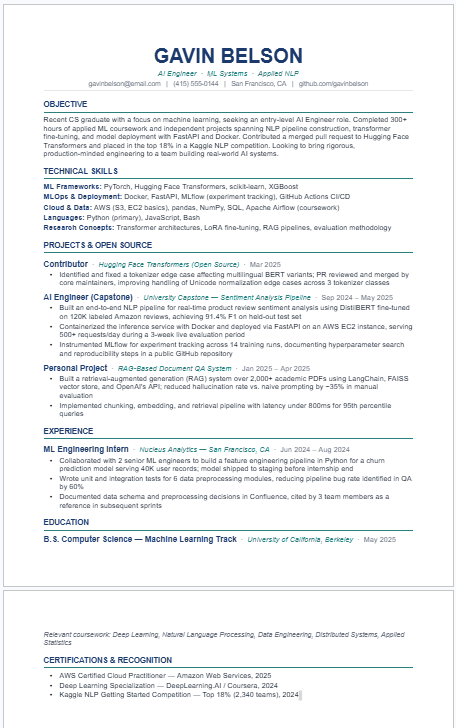
If you are entry-level or transitioning from a related field like software engineering, data science, or academic research, use an objective statement that connects your existing background to AI engineering credibly.
“Software engineer with 3 years of backend experience transitioning into AI engineering, with hands-on project experience in transformer fine-tuning, model deployment using FastAPI and Docker, and ML pipeline construction with Airflow. Looking to bring strong systems engineering fundamentals to an applied ML team.”
A few principles apply regardless of experience level:
Build a Skills Section That Speaks to Hiring Managers
AI engineering pulls from more disciplines than almost any other technical role: ML research, software engineering, data infrastructure, and cloud platforms all overlap here. Without clear organization, your skills section becomes a wall of text that hiring managers skim past. Structure is everything. So, to make your AI engineering skills stand out, you need to organize them into clear categories. For example:
- ML Frameworks and Libraries: PyTorch, TensorFlow, JAX, Hugging Face Transformers, scikit-learn, XGBoost, LightGBM
- LLMs and Generative AI: GPT-4, Claude 3, Gemini 1.5, Llama 3, Mistral, fine-tuning (LoRA, QLoRA), RLHF, RAG pipeline design
- MLOps and Infrastructure: MLflow, Kubeflow, Weights & Biases, DVC, Airflow, Docker, Kubernetes, Ray
- Model Serving and Deployment: Triton Inference Server, TorchServe, BentoML, FastAPI, ONNX, TensorRT, latency optimization
- Cloud and Data Infrastructure: AWS SageMaker, Google Vertex AI, Azure ML, Spark, dbt, Snowflake, feature stores
- Programming Languages: Python, SQL, C++ (for inference optimization), CUDA (if applicable)
A few things to get right here:
How to Frame Your Work Experience as an AI Engineer
AI engineering work is complex, spans multiple systems, and often involves contributions that are hard to isolate cleanly.
A model you fine-tuned depends on a data pipeline someone else built. An inference optimization you shipped improved latency across a system that three teams contributed to. Framing this kind of collaborative, layered work on a resume without either overstating or underselling your contribution is the core challenge of the work experience section. Here is how to approach it:
❌ Instead of:
“Developed and deployed machine learning models for production use”
✅ Try:
“Built and maintained the ML ranking system powering product recommendations for 15 million monthly active users, owning the full pipeline from feature engineering through model serving.”
The second version establishes scale, scope, and ownership before a recruiter reads a single technical detail.
A rough structure for each role entry:
AI Engineer | B2B SaaS Company (Series C) | San Francisco, CA | Aug 2021 – Present
Quantify Your Impact With Metrics
AI engineering offers more quantification opportunities than most technical roles. The challenge is knowing which metrics carry weight with recruiters and how to surface them when your work was part of a larger system. Here are some pointers that you can use:
Model performance metrics
Training and experimentation efficiency
Production and infrastructure metrics
Business and product metrics
What to do when clean metrics are not available
Not every AI engineering role produces tidy numbers. If your team did not instrument evaluations formally, quantify the scope instead.
For example, how many models did you maintain in production simultaneously? Across how many data modalities? What was the scale of the training data you worked with? What was the traffic volume your serving infrastructure handled?
Scope metrics are weaker than outcome metrics but significantly stronger than purely descriptive bullets.
One practical step before writing your resume: pull up old experiment tracking logs, MLflow runs, or monitoring dashboards from past roles. Metrics you did not think to record formally often exist in tooling you have already forgotten about. A 20-minute audit of past experiment logs frequently surfaces numbers that strengthen multiple resume bullets.
How to Include Research Papers, Patents, or Publications
Research output is a meaningful signal in AI engineering hiring, but only if you present it in a way that connects it to engineering impact. A publications list that reads like an academic CV tells a product-focused recruiter very little.
The goal is to frame your research contributions in terms of what they demonstrate about your technical depth and how they relate to the work you are applying to do. Here’s how to present your research and publications in a professional manner:
Where to put it
If publications or patents are central to your candidacy, give them their own section titled “Publications,” “Research,” or “Patents,” placed after your experience section.
If you have one or two relevant papers but your candidacy is primarily engineering-driven, a brief mention within your experience bullets or a single-line reference in your skills section is enough.
How to list papers
Include the paper title, venue or journal, year, and your authorship position. First authorship carries more weight than middle authorship, and a top-tier venue (NeurIPS, ICML, ICLR, ACL, CVPR) carries more weight than a workshop paper. Be accurate about both. For example,
“Efficient Fine-Tuning of Large Language Models via Sparse Adapter Layers” – NeurIPS 2023, Second Author”
Connect research to engineering relevance
A bare citation tells a recruiter you published something. A brief annotation tells them why it matters for the role. For example,
“Efficient Fine-Tuning of Large Language Models via Sparse Adapter Layers” – NeurIPS 2023. Introduced a parameter-efficient fine-tuning method, later implemented in two production systems at [Company].
The annotation does not need to be long. One sentence connecting the research to applied impact is enough.
For patents, include the patent title, filing or grant date, and patent number if granted. Note whether it is filed, pending, or granted, since these carry different weights. If the patent directly relates to a system you built in a listed role, reference it in that role’s bullets as well.
For preprints and arXiv papers, include them if the work is substantive and you can speak to it technically in depth. Listing a preprint that never progressed beyond a rough draft signals less than listing nothing at all.
What not to do
Do not pad this section with tangentially related papers you contributed to minimally. Recruiters at AI companies often read publications sections closely, and a paper where you are the seventh author on a topic unrelated to your target role adds noise without adding signal.
How to Include Open Source Contributions and Side Projects
Open source contributions and side projects carry more weight in AI engineering hiring than in most other engineering disciplines. The field moves fast, formal job titles are still catching up to the actual work, and many of the strongest AI engineers built their foundational experience outside of paid roles.
Recruiters know this and evaluate portfolios seriously. So, here’s how you can take advantage of this:
For side projects, document the technical specifics. Name the models, frameworks, datasets, and evaluation methodology. Show that the project was engineered, not just experimented with.
AI Engineer Resume Examples
Entry-Level AI Engineer Resume
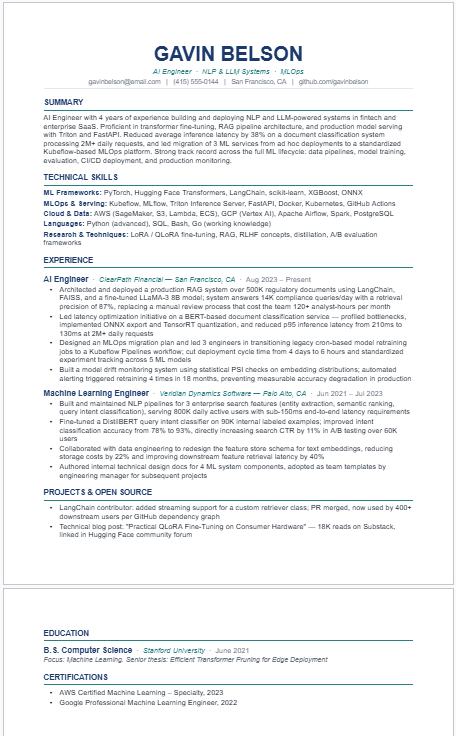
Mid-Level AI Engineer Resume
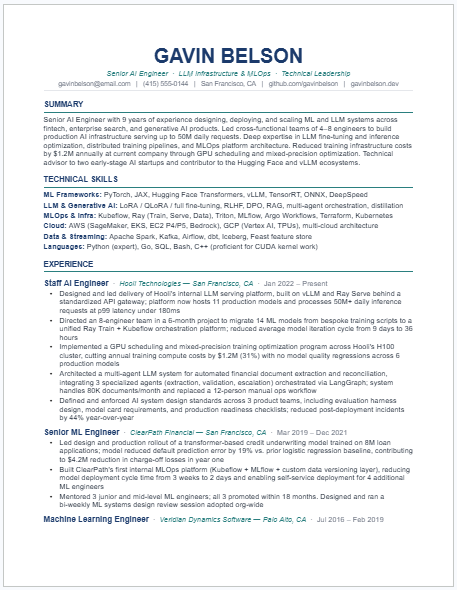
Senior AI Engineer Resume
What to Do If Your Job Title Wasn’t “AI Engineer”
AI engineering as a formal title is relatively recent, and a large portion of practitioners are carrying titles like Machine Learning Engineer, Data Scientist, Research Engineer, Software Engineer, or MLOps Engineer. The mismatch is manageable if you handle it deliberately. Here’s how you can handle it:
“Machine learning engineer with 4 years of experience who has spent the last two years focused on LLM fine-tuning, model serving infrastructure, and MLOps pipeline design for production systems.”
What not to do: Do not retitle past roles as “AI Engineer” if that was not your actual title. It creates inconsistencies that surface when recruiters cross-reference your LinkedIn profile or contact references. Accurate framing with strong supporting detail is always more credible than a clean title with thin evidence behind it.
How to Frame ML Engineering Work as AI Engineering
Most ML engineering work is AI engineering work. The distinction is largely one of terminology catching up to practice.
If you were building training pipelines, deploying models to production, managing inference infrastructure, or working with large-scale neural networks, that experience belongs on an AI engineering resume without much reframing.
The places where framing actually matters:
The core reframing is straightforward: lead with what you built and how it ran in production, rather than what the model achieved in an experiment.
Common AI Engineer Resume Mistakes to Avoid
Here are 7 common AI engineer resume mistakes you should avoid:
Why It’s Important to Tailor Your Resume for Different AI Engineer Roles
AI engineering roles vary significantly across companies. An MLOps-focused role at an enterprise company requires a different emphasis than a generative AI role at an AI-native startup.
Tailoring your resume for each of these manually is slow, and generic resumes in a technically demanding field get filtered out quickly.
This is where an AI resume optimizer tool like Upplai can help. Here’s how Upplai can simplify your search for a suitable agentic AI specialist role:
If you’re worried about getting trapped in subscription fees, Upplai’s pricing is straightforward. You get 200 ATS scores per month, three tailored resumes, and unlimited downloads with no credit card in the free plan. If you need additional resumes, you can pay $0.50 and $1.00 each with no subscription attached.