


TL;DR
Agentic AI is one of the fastest-moving areas in the tech industry right now, and hiring for it is still catching up. Job descriptions vary widely. Titles are inconsistent. Most resume advice was written for roles where the work is easier to standardize.
That’s why this resume guide on agentic AI specialist walks you through every section of your resume with concrete examples.
What Makes an Agentic AI Specialist Resume Different From Other AI Resumes
Most AI-related job resumes are evaluated on model development, infrastructure, or prompt design in isolation. Agentic AI adds a different layer of complexity entirely.
As an agentic AI specialist, you are designing systems that plan, reason, use tools, and take actions autonomously across multiple steps and environments. Recruiters evaluating these resumes expect you to understand agent architectures, failure modes in long-horizon tasks, tool use and function calling, memory systems, and multi-agent coordination.
The agentic AI resume challenge is demonstrating that you can build systems that are capable, reliable, and controllable.
What Recruiters Look for in an Agentic AI Specialist Resume
Recruiters hiring for agentic AI roles are typically senior engineers or technical leads who have tried to build these systems themselves. They know how quickly agentic pipelines break in production, and they are scanning your resume for evidence that you do too. Surface-level familiarity with LangChain or AutoGen will not hold up in a technical screen.
Core Technical Competencies
Recruiters want to see explicit hands-on experience with the tooling and techniques specific to agentic systems. This means naming the frameworks you have built agents with (LangChain, LlamaIndex, AutoGen, CrewAI, LangGraph, Semantic Kernel), the models you have orchestrated across (GPT-5, Claude 4, Gemini 3), and the infrastructure that supported your agent deployments.
Beyond tooling, they look for specific technical capabilities: function calling and tool use implementation, memory system design (short-term, long-term, episodic), retrieval-augmented generation within agentic pipelines, structured output enforcement, and agent state management.
Listing “built AI agents” without any of this specificity reads as surface-level to anyone who has worked in this space.
Agent Architecture and Design Knowledge
Recruiters want to see that you understand how to design agent systems at an architectural level. For example, single-agent versus multi-agent tradeoffs, orchestrator and subagent patterns, task decomposition strategies, planning and replanning mechanisms. And how to scope agent autonomy appropriately for different use cases.
They also want evidence that your architectural decisions are grounded in an understanding of where agentic systems fail. Infinite loops, cascading errors across agent chains, context window exhaustion, and tool call hallucinations are failure modes that experienced practitioners anticipate and design around.
If your resume reflects awareness of these constraints, it signals genuine depth.
Production and Reliability Experience
Agentic systems in production are harder to maintain than standard LLM pipelines. A single prompt call either works or it does not. An agentic workflow can fail at any of dozens of decision points. Diagnosing those failures requires different tooling and thinking than conventional software debugging.
Recruiters look for specific reliability signals. Such as agent observability and tracing tools (LangSmith, Weights & Biases Weave, Arize), interrupt and approval mechanisms for human-in-the-loop workflows, and more.
If you have shipped agentic systems that run reliably at scale, the details of how you achieved that reliability belong prominently on your resume.
Portfolio and Demonstrable Systems
Agentic AI portfolios carry more weight here than in almost any other AI specialty. That’s because the field is new enough that formal job experience is rare. Also, the gap between someone who has actually built production agentic systems and someone who has run tutorials is enormous.
Recruiters want to see documented systems with clear architecture decisions. Your resume needs to answer questions like what the agent did. What tools did it have access to? How did you handle failure cases? What did reliability look like in practice?
A well-documented agentic project that addresses these questions honestly is more compelling than a polished demo that glosses over the hard parts.
How to Write an Agentic AI Specialist Resume Step by Step
Write a Targeted Summary or Objective
Agentic AI is new enough that recruiters cannot rely on job titles to tell them what you actually know. Your resume summary needs to do that work immediately. That is to establish which part of the agentic AI space you operate in before a recruiter reads a single bullet point.
If you already have solid experience (2+ years), write a professional summary. Lead with your years of experience and the types of agentic systems you have built. Follow with two or three specific technical strengths directly relevant to your target role. Close with a production-scale outcome that demonstrates you have shipped something real.
❌ A weak summary looks like this:
“AI professional with experience building autonomous agents and agentic workflows using the latest LLM frameworks and tools.”
✅ A stronger one looks like this:
“Agentic AI specialist with 4 years of experience designing and deploying multi-agent systems for enterprise process automation. Proficient in LangGraph orchestration, tool use architecture, and human-in-the-loop workflow design across GPT-5.5 and Claude 4.6. Reduced manual processing time by 70% across a five-agent document review pipeline handling 10,000+ monthly tasks.”
The second version names a domain, specific frameworks, an architectural specialty, and a production outcome. A recruiter knows exactly what kind of agentic AI engineer you are within two sentences.
If you are entry-level or transitioning from prompt engineering, ML engineering, or software development, use an objective statement that connects your existing background to agentic AI credibly.
“Prompt engineer transitioning into agentic AI development, with hands-on project experience building task decomposition pipelines using LangGraph and AutoGen, implementing tool use with function calling across GPT-5.5 and Claude 4.6 and designing fallback mechanisms for multi-step agent workflows.”
A few principles apply regardless of experience level. For example,
Build a Skills Section That Speaks to Hiring Managers
Agentic AI pulls from more disciplines than almost any other AI specialty: LLM orchestration, software engineering, tool integration, memory systems, and reliability engineering all overlap here. Without clear organization, your skills section becomes unreadable. So, to make your agentic AI skills stand out, you need to organize them into clear categories. For example:
- Agent Frameworks and Orchestration: LangChain, LangGraph, LlamaIndex, AutoGen, CrewAI, Semantic Kernel, Haystack
- Models and APIs: GPT-5.5, Claude 4.6 Sonnet, Gemini 3.1 Pro, Mistral Large, Llama 3.1, function calling, structured outputs
- Memory and Retrieval: Vector databases (Pinecone, Weaviate, Chroma), short-term and long-term memory design, episodic memory, RAG pipeline architecture
- Tool Use and Integrations: Function calling, API orchestration, browser use, code execution environments, external tool integration (search, databases, communication APIs)
- Observability and Reliability: LangSmith, Weights & Biases Weave, Arize, agent tracing, human-in-the-loop design, retry and fallback strategies, cost management
- Supporting Technical Skills: Python, REST APIs, JSON schema design, Docker, cloud platforms (AWS, GCP, Azure)
A few things to get right here:
How to Frame Your Work Experience as an Agentic AI Specialist
Agentic AI work is harder to frame on a resume than most technical roles. The systems are complex. Failures are common and instructive. Much of the work is experimental. And the outcomes can sound deceptively simple to someone who has never tried to build one. Your job is to make the engineering complexity visible without turning each bullet into a paragraph in the work experience section.
Here is how to approach it:
❌ Instead of: “Built multi-agent pipeline using LangGraph and GPT-5.5”
✅ Try: “Designed and maintained a five-agent document processing pipeline using LangGraph and GPT-5.5, handling 10,000+ monthly enterprise contracts with end-to-end task completion from ingestion through structured output delivery.”
A rough structure for each role entry:
Agentic AI Specialist | HR Tech Startup (Series B) | New York, NY | Mar 2023 – Present
Quantify Your Impact With Metrics
Agentic AI systems produce more quantifiable signals than most AI work. The challenge is knowing which metrics carry weight with recruiters and how to surface them when your system operated as part of a larger product. Here are some examples that you can use:
Task completion and reliability metrics
Efficiency and automation metrics
Cost and resource metrics
Production and scale metrics
Business and product metrics
What to do when clean metrics are not available
Agentic AI is new enough that many teams have not instrumented evaluations formally. If that is the case, quantify the scope instead. For example, how many agents did your system coordinate? Across how many tools? How many workflow steps did it automate? What was the monthly task volume?
Scope metrics are weaker than outcome metrics but significantly stronger than purely descriptive bullets.
One practical step before writing your resume: pull up LangSmith traces, cost dashboards, or product analytics from past roles. Token consumption logs, completion rate data, and latency traces often exist in tooling you have already forgotten about. A short audit frequently surfaces numbers that strengthen multiple bullets.
How to Include Agentic AI Side Projects and Experiments
Side projects or resumes carry more weight in agentic AI hiring than in almost any other specialty. The field is too new for most candidates to have deep formal experience. Recruiters know this and evaluate personal projects seriously. A well-documented agentic project can outperform a vague professional bullet point from a more established role.
Here’s how to present your agentic AI side projects professionally:
How to Frame Prompt Engineering or ML Work as Agentic AI Experience
If your last title was Prompt Engineer, ML Engineer, or NLP Researcher, your resume likely undersells how much of your work was agentic in practice.
Multi-step prompt chains linked outputs to the next action, often incorporating tool-calling integrations along the way. They also used output validation loops that re-prompted on failure and maintained memory or state across turns.
All of these are agentic architecture patterns, even if they weren’t called that at the time.
When rewriting your bullets, foreground the system behavior rather than the prompt artifact. Instead of “designed structured output prompts for a document extraction pipeline,” write “designed the output validation and re-prompting logic for a multi-step document extraction agent.” The underlying work may be the same; what changes is that the agent’s behavior is now visible.
If you come from an ML background, connect your work to its operational role in an autonomous system. Fine-tuning for instruction following, RLHF for behavioral alignment, and embedding pipelines for retrieval are the infrastructure these systems run on. Make that connection explicit in your bullets.
On the title gap: use a functional clarifier like “ML Engineer (LLM Agent Infrastructure and Tool Use)” and address the trajectory in your summary. Scoped, accurate framing is more credible than an inflated description that doesn’t hold up in a technical screen.
Agentic AI Specialist Resume Examples
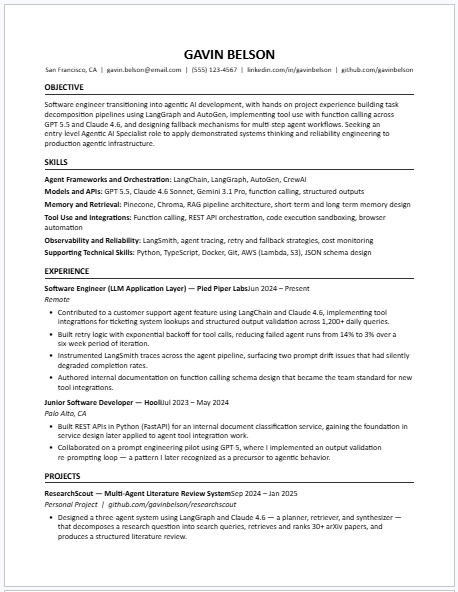
Entry-Level Agentic AI Specialist Resume
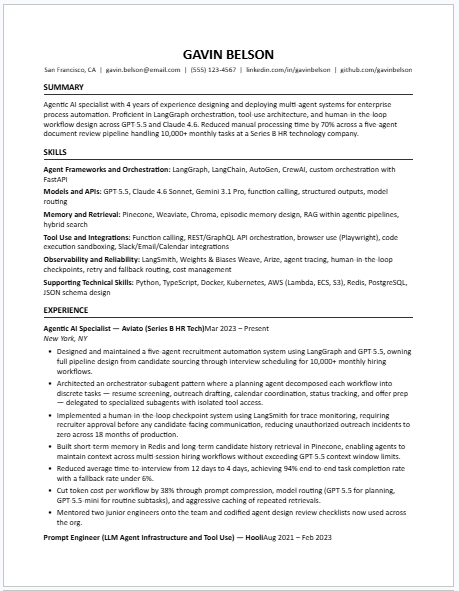
Mid-level Agentic AI Specialist Resume
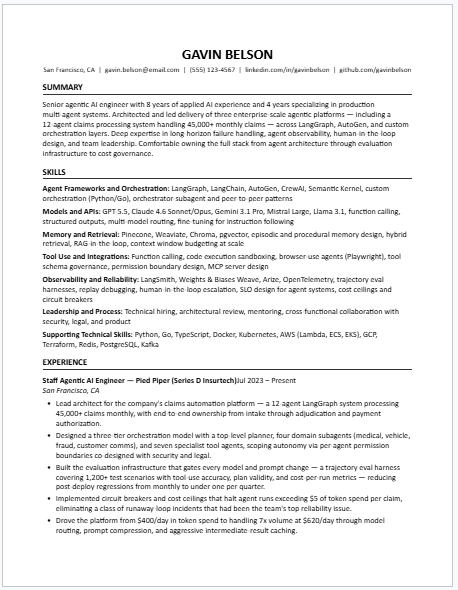
Senior Agentic AI Specialist Resume
Common Agentic AI Specialist Resume Mistakes to Avoid
Describing agent systems without specifying the orchestration layer
Saying you “built multi-agent systems” without naming the framework tells a technical recruiter very little. The orchestration layer is where most of the architectural decisions live, and hiring managers will ask about it directly in a screen.
Name the framework, and if you built custom orchestration, describe the design rationale explicitly.
Listing agentic frameworks you’ve only used through tutorials
Following a LangChain quickstart and designing a production agent with tool-calling, memory management, and failure recovery are two different scopes of experience. Recruiters hiring for agentic roles are technical enough to probe that distinction.
Only list frameworks where you have built something that ran in a real environment, even if that environment was a side project with documented outcomes.
Leaving out failure handling and reliability work
Most resume bullets describe what an agent was supposed to do. Few describe what happened when it didn’t, and how the system handled that. Retry logic, fallback tool routing, human-in-the-loop escalation paths, and output verification layers are core parts of production agentic systems.
If you designed any of these, they belong in your bullets.
Framing single-turn LLM calls as agentic architecture
If your experience is mainly in prompt design for stateless, single-turn completions, that alone won’t support an agentic framing. The architecture for autonomous, multi-step, tool-grounded behavior needs to be reflected somewhere in your resume for it to hold up.
Be precise about where that behavior actually appeared in your work, because technical screens will go there quickly.
Not addressing agent evaluation and observability
Agentic systems are harder to evaluate than single-turn LLMs, and recruiters know it. If you’ve worked on trajectory evaluation, tool-use accuracy metrics, agent benchmarking, or tracing and observability tooling like LangSmith or Weights & Biases, include it.
This work signals maturity in the space and tends to be undersold.
Burying infrastructure work under generic ML experience
Embedding pipelines, vector store architecture, tool schema design, and memory backends are the components agentic systems run on. If your ML or backend engineering work built any of these, bring it forward in your resume and connect it explicitly to its role in an autonomous system.
Sending the same resume to every agentic AI role
Agentic AI roles vary significantly in scope. A role focused on autonomous coding agents calls for different emphasis than one building customer-facing task automation or multi-agent research pipelines. Adjust your summary, your skills emphasis, and your most-foregrounded bullets for the specific system type the role is building.
Why It’s Important to Tailor Your Resume for Different Agentic AI Specialist Roles
Agentic AI roles vary more than most positions in the AI space. A role building autonomous coding agents at an AI-native startup requires a different emphasis than an enterprise role focused on multi-agent workflow automation.
Tailoring your resume for each of these is not optional if you want to compete seriously, but doing it manually for every application is slow and easy to get wrong.
This is where an AI resume optimizer tool like Upplai can help. Here’s how Upplai can simplify your search for a suitable agentic AI specialist role:
If you’re worried about getting trapped in subscription fees, Upplai’s pricing is straightforward. You get 200 ATS scores per month, three tailored resumes, and unlimited downloads with no credit card in the free plan. If you need additional resumes, you can pay $0.50 and $1.00 each with no subscription attached.