

TL;DR
Product management is one of the hardest tech roles to hire for, and resumes in this space are notoriously hard to evaluate. The work is cross-functional. The outcomes are usually team outcomes. The title is inconsistent across companies, and the same PM title at two different businesses can describe completely different work.
That’s why this resume guide on product managers walks you through every section of your resume with concrete examples that hiring managers actually respond to.
What Makes a Product Manager Resume Different From Other Tech Resumes
Most tech resumes get evaluated on direct individual output. A PM resume gets evaluated on something messier: whether your judgment, prioritization, and stakeholder management drove outcomes you cannot fully claim as solo work.
A product manager sits at the center of engineering, design, marketing, sales, and customer success. Hiring managers know this. They scan your resume for evidence that you can scope a problem, make trade-off decisions under uncertainty, ship work that customers actually use, and influence people who do not report to you.
The PM resume challenge is showing that you drove outcomes without overstating your role on team wins. Hiring managers can usually tell the difference between a PM who actually owned a product area and one who took credit for engineering and design work they coordinated.
What Hiring Managers Look for in a Product Manager Resume
Hiring managers for PM roles are typically senior PMs, directors, or VPs who have read thousands of resumes. They have specific signals they look for, and most of them sit below the surface of standard PM bullet points.
Product Judgment
Hiring managers want evidence that you make good calls under ambiguity. This is the hardest thing to demonstrate on a resume. Bullets that mention which features you killed and why, which user research findings changed your roadmap, or which trade-offs you made between speed and quality signal real product judgment.
Bullets that describe shipping features without context for why those features were the right priority signal someone who executes a roadmap rather than someone who shapes one.
Outcome Ownership
Hiring managers want to see that you can connect your work to a business metric and defend the connection. Activation rate, retention, conversion, NPS, revenue, or whatever metric your product team owned. The strongest PM bullets quantify the outcome and acknowledge the team that delivered it without diluting the PM contribution.
A bullet like “drove a 12% lift in week-one activation across a four-person squad through a redesigned onboarding flow” carries more weight than “led the onboarding redesign that increased activation.”
Cross-Functional Influence
PM work is influence work. Most hiring managers will probe how you got engineering, design, and stakeholders aligned on your priorities. Resumes that reference the size of the team you worked with, the stakeholders you partnered with, and the cross-functional projects you led signal someone who can navigate this layer.
Bullets that describe shipping work in isolation, without any reference to the team or stakeholders involved, undersell the part of the job that hiring managers care most about.
Discovery and Validation
Hiring managers want to know how you figure out what to build. Customer interviews, usability testing, data analysis, A/B testing, prototype validation, beta programs. The methods matter less than evidence that you do the work rather than relying on intuition or executive direction.
If your previous roles involved structured discovery work, name the methods explicitly. Hiring managers will scan for it.
Technical Fluency Appropriate to the Role
PM roles vary in technical depth. A platform PM at a developer tools company needs to read API documentation comfortably and have informed opinions on architecture trade-offs. A consumer growth PM at an e-commerce company needs deep fluency in funnel analytics and experimentation. An AI PM needs to understand model evaluation and the limitations of current systems.
Match your technical signals to the role. Listing “technical background” without specifics carries no information.
How to Write a Product Manager Resume Step by Step
Write a Targeted Summary or Objective
Product manager titles are elastic. Two PMs at different companies with the same title can do completely different work. Your resume summary needs to do the work of placing you within the field before a hiring manager reads any further. Three or four sentences is the right length.
If you have two or more years of PM experience, write a professional summary. Lead with your years of experience and the product types you have worked on. Follow with two or three specific strengths that align with the role. Close with a business outcome that anchors your contribution.
❌A weak summary looks like this:
“Customer-obsessed product manager with strong analytical skills and a passion for building products users love.”
✅ A stronger one looks like this:
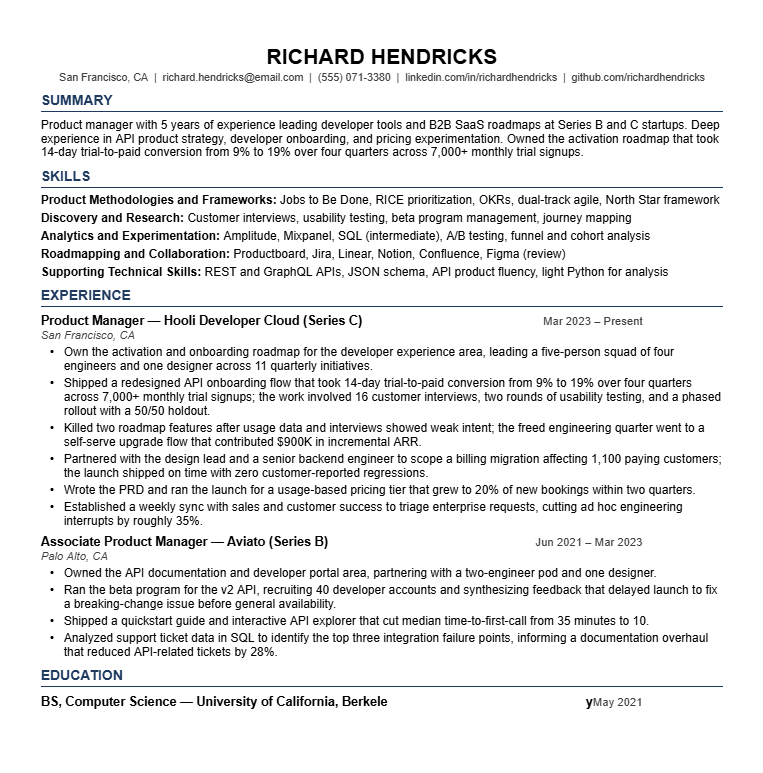
“Product manager with 5 years of experience leading B2B SaaS roadmaps at Series B and C startups. Deep experience in API product strategy, developer onboarding, and pricing experimentation. Owned the activation roadmap that took 14-day trial-to-paid conversion from 8% to 17% over four quarters across 6,000+ monthly trial signups.”
The second version names a domain, a company stage, two specific specialties, and a quantified outcome. A hiring manager reading the first two sentences knows exactly what kind of PM you are.
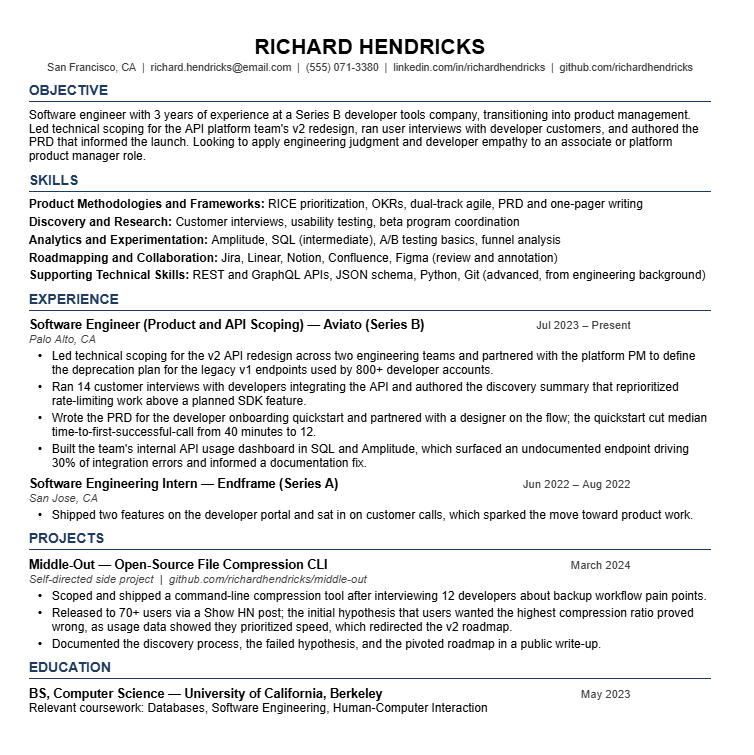
If you are entry-level or transitioning into product management, use an objective statement that connects your existing background to PM work credibly.
“Software engineer with 3 years of experience at a Series B fintech, transitioning into product management. Led technical scoping for the payments team’s API redesign, ran user interviews on developer onboarding pain points, and wrote the PRD that informed the v2 launch. Looking to apply engineering judgment and developer empathy to a platform or developer tools PM role.”
A few principles apply regardless of experience level:
Build a Skills Section That Speaks to Hiring Managers
Product management pulls from a wide range of competencies. Discovery methods, prioritization frameworks, analytics tools, design tools, and technical concepts all overlap here. A flat list of 25 mixed items is hard to read. Organize your skills section into clear categories so hiring managers can find what they need.
- Product Methodologies and Frameworks: Jobs to Be Done, Opportunity Solution Trees, RICE prioritization, Kano model, North Star framework, OKRs, dual-track agile
- Discovery and Research: Customer interviews, usability testing, survey design, persona development, journey mapping, beta program management
- Analytics and Experimentation: Amplitude, Mixpanel, Heap, Pendo, SQL (basic to intermediate), A/B testing, statistical significance, cohort analysis, funnel analysis
- Roadmapping and Collaboration: Productboard, Aha!, Jira, Linear, Notion, Confluence, Miro, FigJam
- Design and Specification: Figma (review and annotation), prototyping basics, PRD and one-pager writing, user flow mapping
- Supporting Technical Skills: API basics, REST and GraphQL concepts, JSON schema reading, Git basics, light Python or R for analysis
A few things to get right here:
How to Frame Your Work Experience as a Product Manager
PM work is one of the hardest jobs to translate to a resume. The work is cross-functional. The outcomes are usually team outcomes. Much of the value sits in decisions and trade-offs that do not show up as deliverables. Your job in the work experience section is to make the product judgment visible without turning each bullet into a paragraph.
Here is how to approach it:
❌ Instead of: “Owned the onboarding roadmap for the growth team.”
✅Try: “Owned the onboarding roadmap for a four-person growth squad at a Series B B2B SaaS company. Shipped six experiments across the activation funnel and took 14-day trial-to-paid conversion from 8% to 17% over four quarters.”
A rough structure for each role entry:
Senior Product Manager | B2B SaaS Company (Series C) | San Francisco, CA | Apr 2023 to Present
Quantify Your Impact With Metrics
PM work produces more quantifiable signals than many people put on their resumes. The challenge is knowing which metrics carry weight with hiring managers and how to surface them when your work was one input into a team outcome.
Here are some examples to draw from:
Business outcome metrics
Scope and ownership metrics
Process and execution metrics
Discovery and validation metrics
Strategic metrics
What to do when clean metrics are not available
PM work often happens at companies that do not formally instrument every initiative. If that describes your last role, quantify the scope instead. How many engineers and designers did you work with? How many customers used the area you owned? How many launches did you ship in a year? What was the volume of stakeholder requests you triaged monthly?
Scope metrics are weaker than outcome metrics, but they are significantly stronger than purely descriptive bullets.
One practical step before writing your resume: pull up old launch retros, OKR documents, dashboard screenshots, and Slack threads with engineering leads. Numbers you have forgotten about tend to surface in those artifacts and strengthen multiple bullets at once.
How to Include PM Side Projects and Pre-PM Work
Side projects on a resume carry weight for APM and PM-1 candidates and progressively less weight as you move into senior PM territory. The signal you want from a side project is that you can run a real product cycle. Identify a customer problem, scope a solution, ship something, and learn from real users.
Here is how to present PM side projects credibly:
How to Frame Engineering, Design, Consulting, or Marketing Work as PM Experience
Most PMs do not start as PMs. Engineering, design, consulting, marketing, customer success, and operations are common pre-PM backgrounds. The challenge is reframing your prior work to surface the product judgment that was already there.
When rewriting your bullets, foreground the product decisions and customer outcomes rather than the function. Instead of “shipped the new payments service,” write “scoped the payments service redesign across three engineering teams, drove the technical decision to deprecate the legacy v1 API, and partnered with two product managers on the migration plan that reached 1,200 customers.”
If you come from a consulting background, connect your client work to product outcomes explicitly. Discovery, prioritization, stakeholder alignment, and roadmap design are all consulting work in product clothing. A hiring manager reading a McKinsey or Bain background looks for evidence that you have applied that thinking to a product team specifically.
If you come from design or research, connect your discovery work to product decisions that shipped. The strongest framing is one where you led the discovery that informed a roadmap, not one where you handed off research and waited.
On the title gap: use a functional clarifier like “Senior Engineer (Product and Roadmap Ownership)” or “UX Researcher (Product Discovery Lead)” and address the trajectory in your summary. Honest framing carries more weight than a fabricated PM title that breaks down in a reference check.
Product Manager Resume Examples
Entry-Level Product Manager Resume Example
Mid Level Product Manager Resume Example
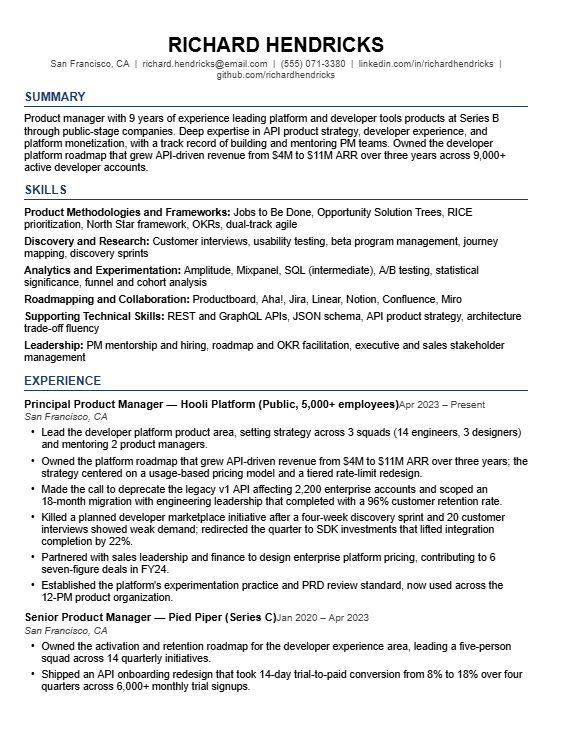
Senior Level Product Manager Resume Example
Common Product Manager Resume Mistakes to Avoid
Listing features shipped without context for why they shipped
A bullet that says “shipped onboarding redesign and API v2” tells a hiring manager what you executed, not why those were the right priorities or what you considered and cut. Senior PM hiring managers read execution-only bullets as junior PM work even when the underlying scope was significant.
Claiming team outcomes as solo work
PM work is collaborative. A bullet that frames a major launch as your individual contribution without any reference to engineering, design, or other partners signals someone who has not yet worked at scale or someone who does not credit teams. Both readings hurt the resume.
Using PM jargon without specificity
“Drove cross-functional alignment to deliver impactful customer outcomes” is the kind of bullet that fills space without communicating anything. Every word in a PM resume bullet should be specific enough that a different PM could not have written the same thing about a different launch.
Inflating technical depth
Listing “technical background” or “engineering fluency” on a resume invites a technical PM screen. If your last engineering work was a Codecademy Python course, that screen will surface the gap. Match your technical signals to your actual depth.
Burying discovery work under feature delivery
Many PMs spend significant time on customer interviews, beta programs, and data analysis that informs what gets built. If that work is invisible on your resume, the bullets read as execution-only. Bring the discovery layer forward.
Not differentiating between roles at different company stages
A PM at a Series A startup, a PM at a 5,000-person public company, and a PM at a hyperscaler do meaningfully different work. Resumes that read identically across these contexts undersell the candidate’s range. Make the company stage and operating context visible in each role entry.
Sending the same resume to every PM role
Growth PM, platform PM, B2B SaaS PM, AI PM, and consumer PM jobs evaluate different signals. A growth PM hiring manager wants experimentation depth. A platform PM hiring manager wants API and developer empathy signals. A B2B PM hiring manager wants enterprise customer and sales partnership signals. Adjust your summary, your skills emphasis, and your most-foregrounded bullets accordingly.
Why You Should Tailor Your Resume for Different Product Manager Roles
Product manager roles vary more than most positions in tech. A growth PM role at a consumer fintech, a platform PM role at a developer tools company, and a B2B SaaS PM role at an enterprise software business all evaluate different signals.
Tailoring your resume for each application is necessary if you want to compete seriously, but doing it manually for every role is slow and easy to get wrong.
This is where an AI resume optimizer tool like Upplai can help. Here is how Upplai simplifies your PM job search:
If you are worried about getting trapped in subscription fees, Upplai’s pricing is straightforward. You get 200 ATS scores per month, three tailored resumes, and unlimited downloads with no credit card in the free plan. If you need additional resumes, you can pay $0.50 or $1.00 each with no subscription attached.