


TL;DR
Customer service roles exist across nearly every industry. Call centers, retail, hospitality, SaaS, healthcare, financial services, and e-commerce all hire for service positions regularly. The job titles vary too: customer support specialist, client success associate, service desk agent, front desk coordinator, and many others.
What most of these roles have in common is that hiring managers want to see the same core things: your ability to handle volume, resolve issues, and keep customers satisfied. General resume advice rarely accounts for these specifics, so this guide walks you through every section of a customer service resume with examples you can actually use.
How to Write a Customer Service Resume That Gets Interviews
Write a Targeted Summary or Objective
Your resume summary is the first thing a hiring manager reads. In customer service hiring, your resume summary needs to establish three things right away: your channel and environment experience, your industry background, and a performance metric that signals you actually delivered results.
But if you have previous experience in a customer-facing role, write a professional summary and keep it to 3 or 4 sentences. You should lead with your years of experience and the type of service environment you worked in. Then, follow with your channel specializations and any relevant tools or platforms. Finally, close with a concrete outcome like a CSAT score, a resolution rate, or a retention figure.
❌A weak summary looks like this:
“Friendly and dedicated customer service professional with a passion for helping customers and a positive attitude.”
✅A stronger one looks like this:
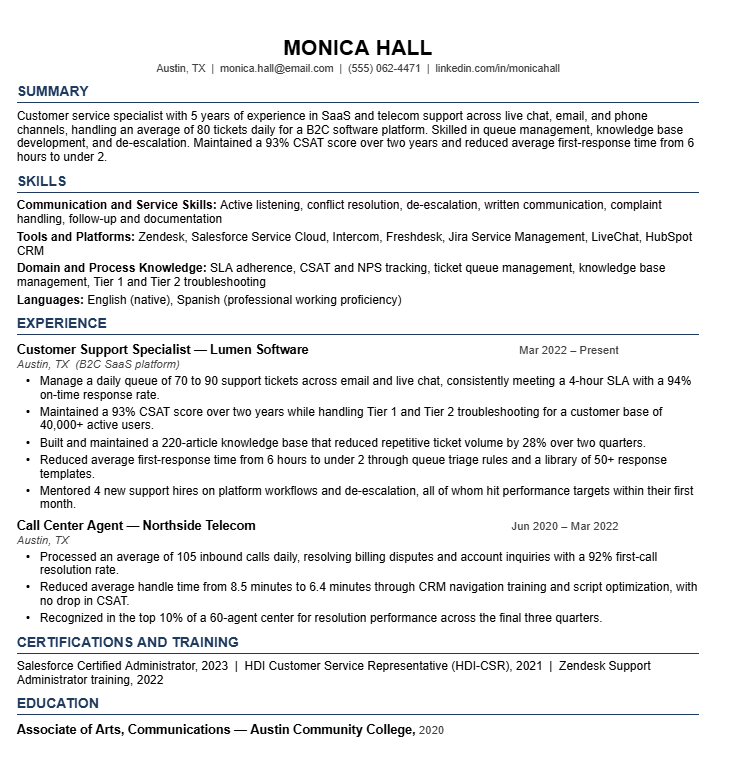
“Customer service specialist with 4 years of experience in SaaS support across live chat and email channels, handling an average of 80 tickets daily for a B2C software platform. Maintained a 92% CSAT score over 18 months and reduced average first-response time from 6 hours to under 2 hours through queue management and template optimization.”
The second version names a setting, a channel, a volume metric, and two performance outcomes. A hiring manager knows exactly what kind of support professional you are before reading a single bullet point.
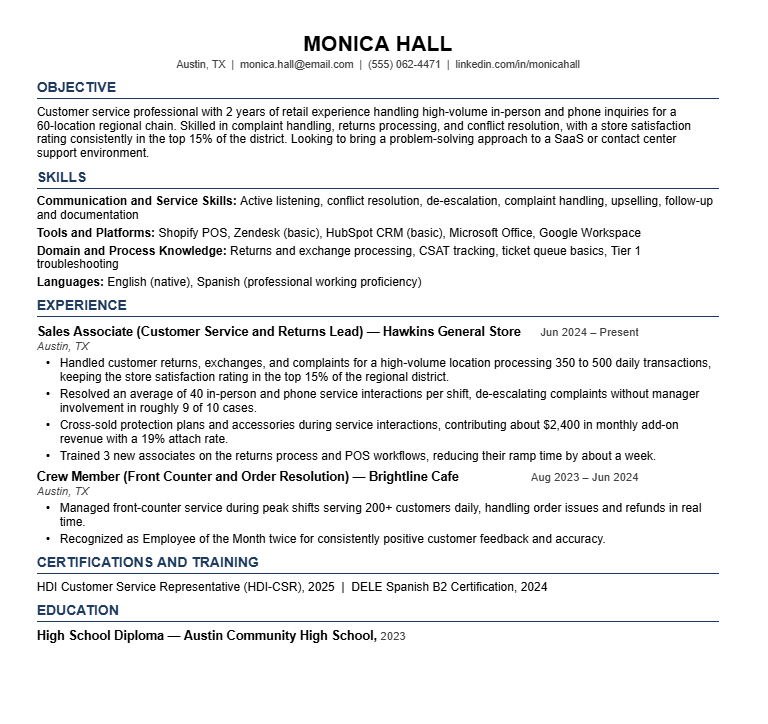
If you are entry-level or transitioning from a different field, use an objective statement instead. This applies to backgrounds in retail, food service, hospitality, or any public-facing work.
“Recently certified customer service professional with 2 years of retail experience handling high-volume in-person and phone inquiries for a 500-location national chain. Looking to bring a problem-solving approach to a tech support or SaaS environment.”
A few principles apply regardless of experience level:
Build a Skills Section That Speaks to Hiring Managers
Customer service roles require a wider range of skills than the job title suggests. Communication ability, platform proficiency, domain knowledge, and language skills all belong on your resume, but they need to be organized into clear, readable categories. A flat list of 20 mixed items is easy to ignore.
Here is how to structure your skill section for a customer service role:
- Communication and Service Skills: Active listening, conflict resolution, de-escalation, written communication, complaint handling, upselling and cross-selling, empathy-based service, follow-up and documentation
- Tools and Platforms: Zendesk, Salesforce Service Cloud, Freshdesk, Intercom, Gorgias, HubSpot CRM, Jira Service Management, LiveChat, Shopify, Five9, NICE inContact
- Domain and Process Knowledge: SLA adherence, CSAT and NPS tracking, ticket queue management, knowledge base management, chargeback and return processing, onboarding support, technical troubleshooting (Tier 1/Tier 2)
- Language Proficiencies: English (native), Spanish (professional working proficiency), French (conversational)
A few things to keep in mind when building this section:
Write Achievement-Focused Experience Bullets
Customer service resume bullets tend to describe responsibilities rather than results. “Responded to customer inquiries” and “resolved complaints via phone and email” tell a hiring manager what the job involved, not what you produced while doing it. Use this formula for each bullet:
[Action verb] + [specific task or method] + [quantifiable result or scope]
Compare these two approaches:
❌ Weak: “Handled customer service calls and resolved issues for clients.”
✅ Strong: “Resolved an average of 95 inbound calls daily for a telecom support center, maintaining a 91% first-call resolution rate and a 4.6/5 post-call CSAT score across a 12-month period.”
The second version gives a hiring manager three things to evaluate: your volume capacity, your resolution performance, and your satisfaction score.
Here are more examples across different customer service roles:
Customer Support Specialist (SaaS)
Retail Customer Service Associate
Call Center Agent
Client Success Coordinator
When clean metrics are unavailable, quantify the scope instead. How many customers did you interact with daily? What was the size of the team or center? What ticket volume did you manage? Scope metrics are weaker than outcome metrics but significantly stronger than purely descriptive bullets.
One practical step before writing your resume: log into any CRM or support platform you used and check ticket history, resolution data, or CSAT reports. Numbers you have forgotten tend to surface there and can strengthen several bullets at once.
Organize Your Work History the Right Way
Customer service candidates sometimes underestimate how transferable their experience is across industries.
A background in retail service is relevant for SaaS support. Healthcare front desk work translates to financial services. Food service and hospitality experience covers skills that contact center managers look for directly.
The key is framing your role entries so the relevant skills are visible, not buried under industry-specific context.
Each role entry should include your job title, the company name, the location, and your dates of employment. Under that, include two to five bullets depending on how relevant the role is to your target position. Your most recent and most relevant role should have the most detail.
If your official job title was something generic like “team member” or “associate” but your work was primarily service-focused, add a functional clarifier in parentheses next to your title: “Team Member (Customer Service and Returns Lead).” This gives a hiring manager context without misrepresenting your credentials.
Showcase Relevant Certifications and Training
Customer service does not have the same credential-heavy requirements as industries like fitness or finance, but certifications and training still signal that you take the role seriously and have invested in professional development.
If you hold any of the following, list them in a dedicated section near the bottom of your resume:
Include the certifying body and the year completed or the current validity date for each one. If you completed internal training programs at a previous employer, like a customer excellence program or a Zendesk admin course, list those under “Professional Development” rather than grouping them with formal certifications.
Customer Service Resume Examples
Entry-Level Customer Service Resume Example
Mid Level Customer Service Resume Example
Common Customer Service Resume Mistakes to Avoid
Describing tasks instead of outcomes
Bullets like “assisted customers with their inquiries” or “answered phone calls” describe what the job involved, not how well you performed it. Hiring managers want to see CSAT scores, resolution rates, ticket volumes, and retention figures. Pull those numbers before writing your resume.
Using the same resume for every customer service role
A contact center role for a financial services firm and a client success position at a SaaS startup are looking for different things. Sending the same resume to both reduces your fit signal in each. Adjust your summary, your skills emphasis, and your most relevant bullets for the specific role and industry you are applying to.
Leaving out tool and platform proficiency
Most customer service roles require proficiency with a specific CRM or ticketing system. If Zendesk, Salesforce, Freshdesk, or another platform appears in the job description, make sure it is visible on your resume if you have used it. Hiring managers frequently filter on this.
Burying multilingual skills
If you are fluent or professionally proficient in a second language, that belongs in a clearly visible section near the top of your skills. Bilingual candidates are in high demand across healthcare, retail, and financial services support roles, and this credential is easy to overlook when buried at the bottom of a flat skills list.
Ignoring ATS formatting requirements
Creative templates with graphics, columns, or icons often fail ATS parsing. Use standard fonts, clear section headers, and simple bullet points. If the job description names specific tools or phrases like “first-call resolution” or “CSAT management,” use that exact language in your resume.
Leaving out soft skills entirely
Customer service hiring managers evaluate technical fit and interpersonal fit. De-escalation, active listening, empathy, and written communication are real differentiators. Include them in your skills section under a clearly labeled category rather than omitting them because they feel too obvious to mention.
Omitting informal or freelance customer service work
If you have done freelance support work, virtual assistant roles with a service focus, or volunteer work in a public-facing capacity, document it the same way you would a formal role. Include the timeframe, the scope of your work, and any measurable outcomes. Hiring managers in this field will consider it.
Why You Should Tailor Your Resume for Different Customer Service Roles
Customer service roles vary more than the shared job title suggests. A contact center role at a financial services firm looks for different things than a client success position at a SaaS startup or a front desk role in healthcare. One weighs call volume and first-call resolution, another weighs account retention and onboarding, and another weighs in-person de-escalation and scheduling.
Tailoring your resume for each application is necessary if you want to compete seriously, but doing it manually for every role is slow and easy to get wrong.
This is where an AI resume optimizer tool like Upplai can help. Here is how Upplai simplifies your customer service job search:
- Real-time ATS scoring: Upplai updates your ATS score as you edit, so you can see the impact of every change instantly rather than re-uploading your resume each time.
- Transparent suggestions: Every recommendation comes with a clear reason behind it and controls. You can accept or reject it in one click without guessing about the logic.
- Automatic formatting: You get a clean, ATS-friendly resume without adjusting a single margin or font size after every edit.
- Structure guidance: Upplai guides you on resume writing best practices developed by recruiters and resume coaches. It also flags content that can lead to potential recruiter bias.
- Preference memory: Your CSAT scores, resolution metrics, section ordering, and formatting choices carry over each time you apply somewhere new, saving you hours over your job search.
If you are worried about getting trapped in subscription fees, Upplai’s pricing is straightforward. You get 200 ATS scores per month, three tailored resumes, and unlimited downloads with no credit card in the free plan. If you need additional resumes, you can pay $0.50 or $1.00 each with no subscription attached.