

TL;DR
- To write a fitness industry resume, list every certification with the issuing body and expiration date. Many facilities verify credentials before onboarding, and an incomplete or lapsed certification can remove you from consideration before a hiring manager reads your experience
- Write outcome-focused bullets, not session descriptions. Include client load, retention rates, revenue contribution, and measurable client progress, which are what hiring managers are actually looking for
- Organize your skills into clear categories: certifications and credentials, specializations, client management and business skills, and supporting technical skills
- Your resume summary needs to name your primary certification, your specialization, and a concrete outcome within the first two sentences
- Independent client work and side coaching count as real experience if you document them properly
The fitness industry has more job openings than most people realize. Personal training, group fitness, strength and conditioning, facility management, online coaching, and corporate wellness are all popular roles.
However, the hiring process varies widely depending on the facility type, and most general resume advice was not written with fitness roles in mind.
That’s why we have created this guide on how to write a fitness industry resume, where we walk you through every section of your resume with ATS-friendly examples.
What Makes a Fitness Industry Resume Effective?
Fitness roles sit at the intersection of health, performance, and client relationships, and hiring managers evaluate resumes with all three in mind. A gym owner looks for evidence that you can build a client base, retain it, and produce measurable results.
The dual challenge with fitness resumes is that certifications establish your baseline eligibility, but they do not differentiate you. Most applicants for a personal trainer role will have an NASM or ACE cert.
What separates competitive candidates is outcome data: client retention rates, revenue generated, program completion rates, or measurable client progress. Your resume needs to show both.
How to Write a Fitness Industry Resume That Gets Interviews
Here’s how you can write a resume for applying to a fitness industry role in 5 steps:
Write a Targeted Summary or Objective
Your resume summary is the first thing a hiring manager reads. In the fitness industry, it needs to establish three things immediately: your certification baseline, your specialization, and a result that shows you can actually move the needle for clients or a facility.
If you have previous experience in the fitness industry, write a professional summary. While writing the summary, remember to keep it to three or four sentences.
Also, lead with your years of experience and the type of fitness environment you have worked in. Then, follow with your primary certifications and any specializations. And finally, close with a concrete outcome. It could be client retention, revenue contribution, or a measurable client result.
❌ A weak summary looks like this:
“Passionate and motivated personal trainer with strong communication skills and a love for helping clients reach their fitness goals.”
✅ A stronger one looks like this:
“NASM-certified personal trainer with 5 years of experience in commercial gym and boutique studio settings, specializing in strength and conditioning for general population adults. Maintained an 85% client retention rate over 12 months and grew a personal training book of business from 10 to 34 active clients within the first year at current facility.”
The second version names a certification, a setting, a specialization, and two concrete outcomes. A hiring manager knows exactly what kind of fitness professional you are before reading a single bullet point.
If you are entry-level (i.e. have less than 2 years of experience) or transitioning from a related field, use an objective statement. This applies to backgrounds like athletics, physical education, or healthcare. Make sure it connects your experience to fitness work in a credible way.
“Recently NASM-certified personal trainer with a background in collegiate athletics and 200+ hours of practical training experience through internship at a high-volume commercial gym. Looking to bring a performance-grounded approach to program design and client coaching in a results-focused facility.”
A few principles apply regardless of experience level:
Build a Skills Section That Speaks to Hiring Managers
Fitness resumes draw from a wider range of competencies than most people organize clearly. These include certifications, movement specializations, client management, and business skills.
All of these belong on the resume, but they need to be separated into clear, readable categories. A flat list of 20 mixed items is easy to ignore. Here is how to structure it:
- Certifications and Credentials: NASM-CPT, ACE-CPT, CSCS, ACSM, ISSA, CPR/AED, First Aid, Pre/Postnatal Fitness Certification, Precision Nutrition PN1
- Specializations: Strength and conditioning, corrective exercise, mobility and flexibility training, group fitness instruction, HIIT programming, sports performance, weight management, senior fitness, youth athletics
- Client Management and Business Skills: Client retention, program design and periodization, fitness assessments and goal setting, behavior change coaching, sales and membership conversion, session scheduling, progress tracking
- Supporting Technical Skills: Mindbody, Trainerize, TrueCoach, Microsoft Office, Google Workspace, basic nutrition planning, injury screening protocols
A few things to keep in mind when building this section:
Write Achievement-Focused Experience Bullets
Your experience bullets have a tendency to read as job descriptions rather than records of actual work. “Designed workout programs for clients” and “conducted fitness assessments” tell a hiring manager what your job involved, not what you produced while doing it.
Use this formula for each bullet:
[Action verb] + [specific task or method] + [quantifiable result or scope]
Compare these two approaches:
❌ Weak:
“Responsible for personal training sessions and client program design.”
✅ Strong:
“Designed and delivered individualized strength and conditioning programs for 28 active clients, achieving an 82% 6-month retention rate and generating $6,400 in monthly recurring personal training revenue.”
The second version gives a hiring manager three things to evaluate: your client load, your retention performance, and your revenue contribution. All three matter in a fitness facility hire.
Here are more examples across different fitness roles:
Personal Trainer
Group Fitness Instructor
Fitness Director
When clean metrics are not available, quantify scope instead. How many clients did you work with weekly? How many classes did you run? What was the size of the facility? Scope metrics are weaker than outcome metrics but significantly stronger than purely descriptive bullets.
One practical step before writing your resume: pull up any client management software you used and check session logs, retention data, or attendance reports. Numbers you have forgotten about tend to surface there and strengthen multiple bullets at once.
Showcase Certifications and Continuing Education
Certifications carry more weight in fitness hiring than in almost any other industry. Many facilities have liability and insurance requirements tied to staff credentials. Because of this, a missing or lapsed certification can disqualify you immediately. This can happen before a hiring manager even reads a single bullet point.
List them prominently, and list them correctly.
The best practice would be to place your certifications either in a dedicated section near the top of your resume or immediately after your name in the header. Include the certifying organization and expiration date for every credential.
Example:
NASM Certified Personal Trainer (CPT) — National Academy of Sports Medicine, Valid through 2027 Certified Strength and Conditioning Specialist (CSCS) — NSCA, Valid through 2028 CPR/AED Certification — American Red Cross, Valid through 2027 Precision Nutrition Level 1 (PN1) — Precision Nutrition, 2025
A few things to get right here:
ATS-friendly Fitness Industry Resume Examples
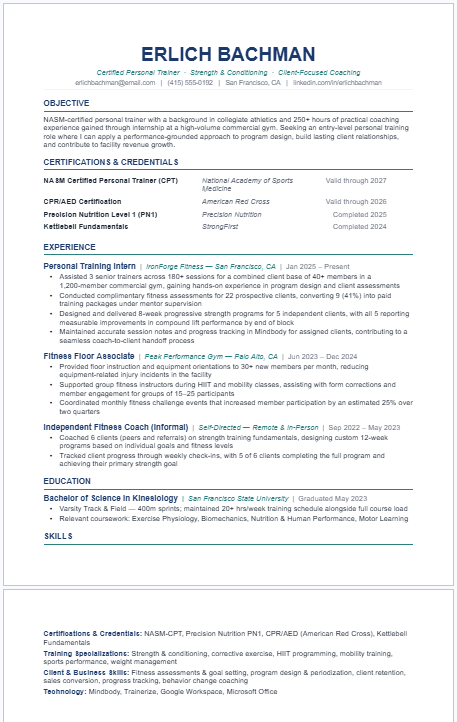
Entry-Level Fitness Industry Expert Resume
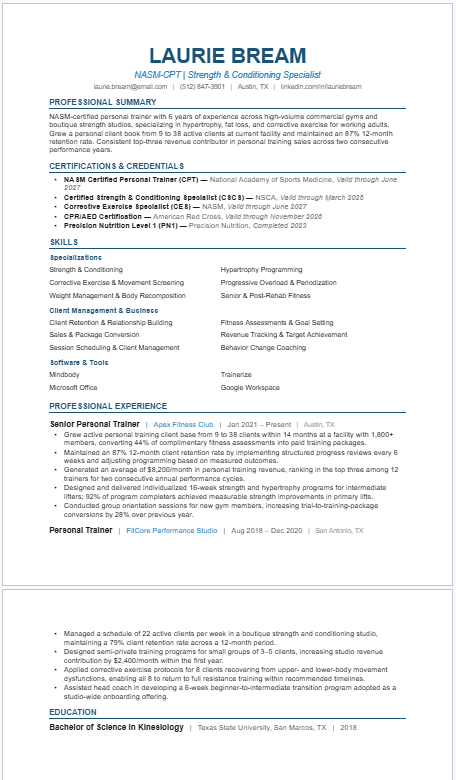
Senior Fitness Industry Expert Resume
Common Fitness Industry Resume Mistakes to Avoid
Listing certifications without expiration dates or certifying bodies
Writing “NASM-CPT” without the certifying organization and validity date leaves hiring managers with unanswered questions before they have finished your header. Many facilities require proof of current credentials before onboarding. Include the full certification name, the issuing body, and the expiration date for every credential on your resume.
Describing sessions instead of outcomes
Bullets like “delivered personal training sessions” or “created workout plans for clients” describe the job function, not your performance within it. Hiring managers want to see client load, retention rates, revenue contribution, and measurable client progress.
If you tracked any of this in Mindbody, Trainerize, or TrueCoach, go back and pull those numbers before writing your resume.
Using the same resume for every fitness role
A boutique studio hiring a group fitness instructor and a corporate wellness facility hiring a health coach are looking for different things. Sending an unmodified resume to both reduces your fit signal in each.
Adjust your summary, your certifications emphasis, and your most relevant experience bullets for the specific role and facility type you are applying to.
Burying your specializations in a flat skills list
A mixed list of 25 items is hard to read and easy to skip. Organize your skills into clear categories so a hiring manager can find your CSCS or your corrective exercise specialization without scanning the entire section.
Overstating nutrition or rehabilitation credentials
Hiring managers at fitness facilities know where a personal trainer’s scope of practice ends. Framing general nutrition guidance as clinical nutrition coaching or movement screening as physical therapy knowledge raises concerns about your understanding of professional boundaries.
List what your credentials actually authorize you to do.
Leaving out client management and business skills
Personal training is a sales-adjacent role at most commercial gyms. If you have experience converting assessments into paid packages, managing a client schedule, or contributing to facility revenue targets, that belongs on your resume.
Hiring managers at commercial facilities weigh this alongside your training competencies.
Ignoring ATS formatting requirements
Creative resume templates with graphics, columns, or icons may look professional, but they frequently fail ATS parsing. Use standard fonts, clear section headers, and simple bullet points.
If the job description mentions specific certifications or software by name, use that exact terminology in your resume.
How AI Resume Builders Can Simplify Your Fitness Resume Optimization
Tailoring your resume for each fitness role is necessary but time-consuming if you are doing it manually for every application. But don’t let this hiccup get in the way of landing your dream role at a fitness company.
To make this process simpler, you can use an AI resume optimizer like Upplai. Here’s how Upplai can simplify your fitness job search:
If you are worried about getting trapped in subscription fees, Upplai’s pricing is straightforward. You get 200 ATS scores per month, three tailored resumes, and unlimited downloads with no credit card in the free plan. If you need additional resumes, you can purchase them individually for $0.50 or $1.00 each, with no subscription required.