

TL;DR
- Include publications for research/academic/technical roles, relevant work, or early-career experience gaps
- List no more than 3-5 most relevant publications, skip if outdated (7+ years old), or you have stronger work experience to showcase
- Use APA citation style, bold your name in author lists, list in reverse chronological order
- Include DOIs/URLs and publication status (In Press, Under Review)
- Place as dedicated section after work experience (3+ publications), integrate it into job descriptions (1-2 publications), or combine it with presentations/awards
- Tailor publications to job requirements, include job specific keywords, and add context for impact (citation counts, practical applications)
Publications can be powerful proof of your expertise, but only if you present them correctly. Whether you’ve authored peer-reviewed research, contributed to industry reports, or published professional articles, knowing how to list publications on your resume can set you apart from other candidates.
In this guide, you’ll learn:
Should You Include Publications on Your Resume?
Not every publication belongs on every resume. The decision depends on three factors: relevance, recency, and your career stage.
Include publications when:
Skip the publications section when:
The key question: Will this publication help the hiring manager understand why you’re qualified for this specific role? If the answer is no, leave it off.
Resume vs. CV: Understanding the Difference
Before formatting your publications, understand whether you need a resume or a curriculum vitae (CV), the distinction affects how you present published work.
| Aspect | Resume | CV (Curriculum Vitae) |
|---|---|---|
| Length | 1-2 pages maximum | 3-20+ pages (no limit) |
| Purpose | Highlights relevant experience for specific job | Comprehensive record of academic/research career |
| Publications | Select 3-5 most relevant | Complete publication history |
| Common Use | Corporate, industry, most US jobs | Academic positions, research roles, international applications |
| Update Frequency | Tailored for each application | Updated as accomplishments occur |
| Focus | Achievement-driven, results-oriented | Chronological, comprehensive documentation |
For most job seekers: You need a resume with a carefully curated publications section, not a comprehensive list. Academic job seekers and researchers typically need both a CV for academic positions and a tailored resume for industry roles.
For more guidance on structuring your resume, see our complete resume writing guide and resume format guide.
How to Format Publications on a Resume
The publications section follows established academic citation formats, but with strategic modifications for resume readability. Choose a citation style and apply it consistently.
Standard Citation Formats
APA Style (Most Common for Resumes):
Copied!Author(s). (Year). Title of article. Journal Name, Volume(Issue), page range. DOI or URL
MLA Style:
Copied!Author(s). "Title of Article." Journal Name, vol. #, no. #, Year, pp. page range.
Chicago Style:
Copied!Author(s). "Title of Article." Journal Name Volume, no. Issue (Year): page range.
Resume-Specific Formatting Tips
Bold your name in the author list to help it stand out:
Reverse chronological order (most recent first) makes it easy for recruiters to see your latest work.
Include publication status for works in progress:
Add context when helpful: A brief parenthetical note can clarify impact for non-specialist readers:
Where to Place Your Publications Section
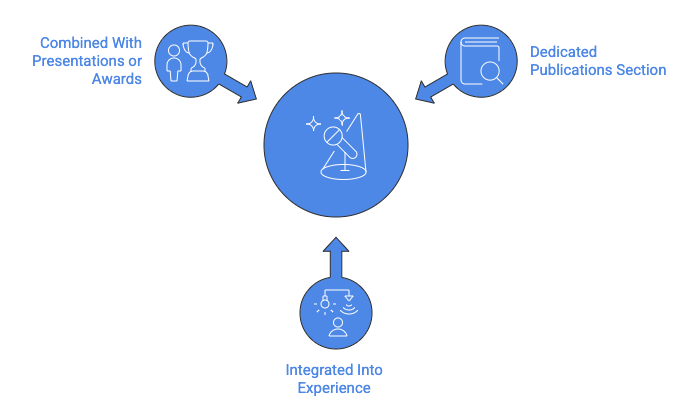
Section placement depends on how central publications are to your qualifications.
Option 1: Dedicated Publications Section
Best for: Candidates with 3+ relevant publications or applying to research-focused roles.
Placement: After your work experience section, before education (unless you’re a recent graduate, then place after education).
Section header options:
Option 2: Integrated Into Experience
Best for: Candidates with 1-2 publications that directly relate to specific work experiences.
Include publications as bullet points under the relevant job entry:
Senior Data Analyst | TechCorp Industries | 2021-Present
Learn more about optimizing your work experience section to integrate publications effectively.
Option 3: Combined With Presentations or Awards
Best for: Candidates with diverse accomplishments beyond publications.
Section header: “Publications & Presentations” or “Research & Recognition”
This approach works well when you have conference presentations, patents, or awards alongside traditional publications.
Publication Examples by Type
Different publication types require slightly different formatting approaches.
Peer-Reviewed Journal Articles
The gold standard for academic and research publications:
Conference Papers and Proceedings
Include the conference name and location:
Industry Reports and White Papers
Emphasize the commissioning organization:
Trade Publications and Professional Articles
Include publication name and circulation when impressive:
Book Chapters
Specify the book title and editors:
Tailoring Publications to Job Applications
Generic publication lists don’t work. The most effective resumes strategically select and present publications based on job requirements. Research from eLife found that among academic job applicants, total citation counts were significantly associated with obtaining offers, but the number of publications alone did not correlate with success. Quality and impact matter more than quantity.
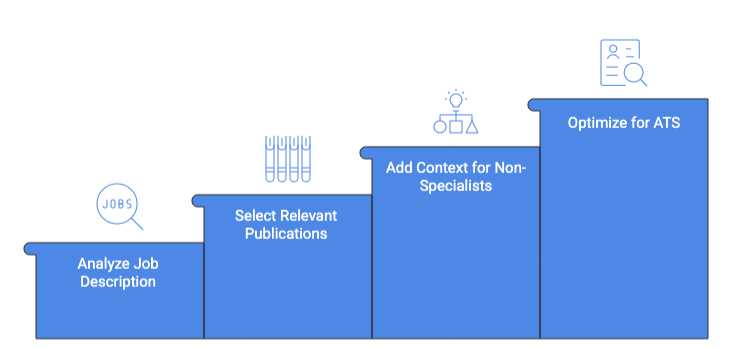
Step 1: Analyze the Job Description
Identify what the employer values:
Step 2: Select Relevant Publications
Choose publications that:
✅ Do This
Example: Applying for a machine learning engineer role at a healthcare company? Prioritize your publication on ML applications in medical imaging over your earlier work on financial modeling, even if the latter appeared in a more prestigious journal.
Step 3: Add Context for Non-Specialists
Hiring managers may not understand academic jargon. Add brief clarifications:
❌ Original
Davis, R. & Kumar, S. (2023). Stochastic gradient descent optimization in distributed systems. ACM Transactions on Computer Systems, 41(2), 1-34.
✅ Improved for industry resume
Kumar, S. & Davis, R. (2023). Stochastic gradient descent optimization in distributed systems. ACM Transactions on Computer Systems, 41(2), 1-34.
(Research on improving AI training speed by 40% in cloud environments)
Step 4: Optimize for ATS
Applicant Tracking Systems scan resumes for keywords from the job description. Ensure your publications section includes relevant terms:
✅ Do This
AI-powered resume builders like Uppl.ai can analyze keyword density and suggest where to naturally incorporate terms from the job description, including in your publications section.
Common Mistakes to Avoid
Listing Irrelevant Publications
The problem: Including every publication regardless of relevance dilutes your message.
The fix: Be selective. A resume isn’t a comprehensive CV. Include only publications that strengthen your case for this specific role.
Inconsistent Formatting
The problem: Mixing citation styles or formatting some entries differently creates a sloppy impression.
The fix: Choose one citation style (APA is most common for resumes) and apply it consistently. Use the same font, spacing, and punctuation throughout.
Outdated Publications
The problem: Publications from 10+ years ago may signal you’re not current in your field.
The fix: For industry roles, focus on publications from the last 5-7 years. For academic positions, include seminal older work but emphasize recent productivity.
Missing Context
The problem: Recruiters can’t assess impact without context.
The fix: Add brief notes about citation counts, awards, or practical applications when they strengthen your case:
Wright, E., Foster, J., & Martinez, C. (2021). Sustainable packaging materials from agricultural waste. Journal of Cleaner Production, 289, 125-138.
(Cited 340 times; led to patent US10234567B2)
Overemphasizing Co-Authorship
The problem: Listing yourself as third author on 15 publications doesn’t demonstrate the same expertise as being first author on 3.
The fix: Note your role when it matters: “First author,” “Corresponding author,” or “Principal investigator.”
Complete Resume Publications Section Example
Here’s how a well-formatted publications section looks in context:
PUBLICATIONS
Harrison, M., Chen, L., & Rodriguez, A. (2023). Real-time anomaly detection in industrial IoT networks using federated learning. IEEE Internet of Things Journal, 10(8), 7234-7248.
Kumar, S., Harrison, M., & Lee, J. (2022). Edge computing architectures for latency-sensitive manufacturing applications. Journal of Manufacturing Systems, 64, 445-459.
(Cited by 89 researchers; implemented by 3 Fortune 500 manufacturers)
Harrison, M. (2022). Cybersecurity frameworks for Industry 4.0 environments. Manufacturing Engineering Magazine, 168(4), 34-41.
(Featured article; readership 75,000+ industry professionals)
Harrison, M., Patel, N., & Thompson, R. (2021). Predictive maintenance using machine learning: A comparative study of algorithms. In Proceedings of the 2021 International Conference on Intelligent Manufacturing (pp. 234-247). Detroit, MI: Society of Manufacturing Engineers.
Time Saving Tip
Reworking your resume for every job posting can consume 40–60 minutes each time. When you’re submitting applications in bulk, that quickly becomes overwhelming. Tools like Upplai scan job descriptions and help you reshape your project highlights to align with what hiring teams are seeking, without exaggeration or losing your personal tone.
Quick Takeaways Checklist
Use this checklist to ensure your publications section is resume-ready:
Selection & Relevance:
Formatting:
Presentation:
Optimization:
Quality Control: