

TLDR;
- Never write “strong work ethic” or “hard worker” directly as these generic phrases get ignored by both ATS systems and recruiters who see them on thousands of resumes
- Use the achievement formula: [Action Verb] + [What You Did] + [Quantifiable Result] + [Context showing reliability/initiative]
- Focus on what employers actually evaluate: consistency patterns, initiative keywords, and quantifiable reliability (99% uptime, 100% delivery rate, zero missed deadlines).
Telling a recruiter you have a “strong work ethic” is like telling them you’re a “team player” or a “hard worker”, it’s vague, overused, and ultimately meaningless buzzwords without proof. Yet work ethic remains one of the most valued soft skills employers seek, especially for roles requiring reliability, initiative, and consistent performance.
The challenge? You can’t just write “excellent work ethic” on your resume and expect recruiters to believe you. You need to demonstrate it through specific achievements, quantifiable outcomes, and strategic language that shows, not tells.
Why “Strong Work Ethic” Doesn’t Work on Resumes
Here’s the problem: Most of the resumes that mention “work ethic” do so in generic terms that Applicant Tracking Systems (ATS) and recruiters immediately discount. When you write “dedicated professional with strong work ethic,” you’re using the same language as thousands of other applicants.
What recruiters actually want to see:
The difference between showing and telling work ethic can determine whether your resume gets past recruiters, and ATS filters and lands in front of hiring managers. This matters because more than 70% of employers cite strong work ethic as high on their wish list, and 90% of employers value candidates who demonstrate reliability and dedication.
What Work Ethic Actually Means to Employers
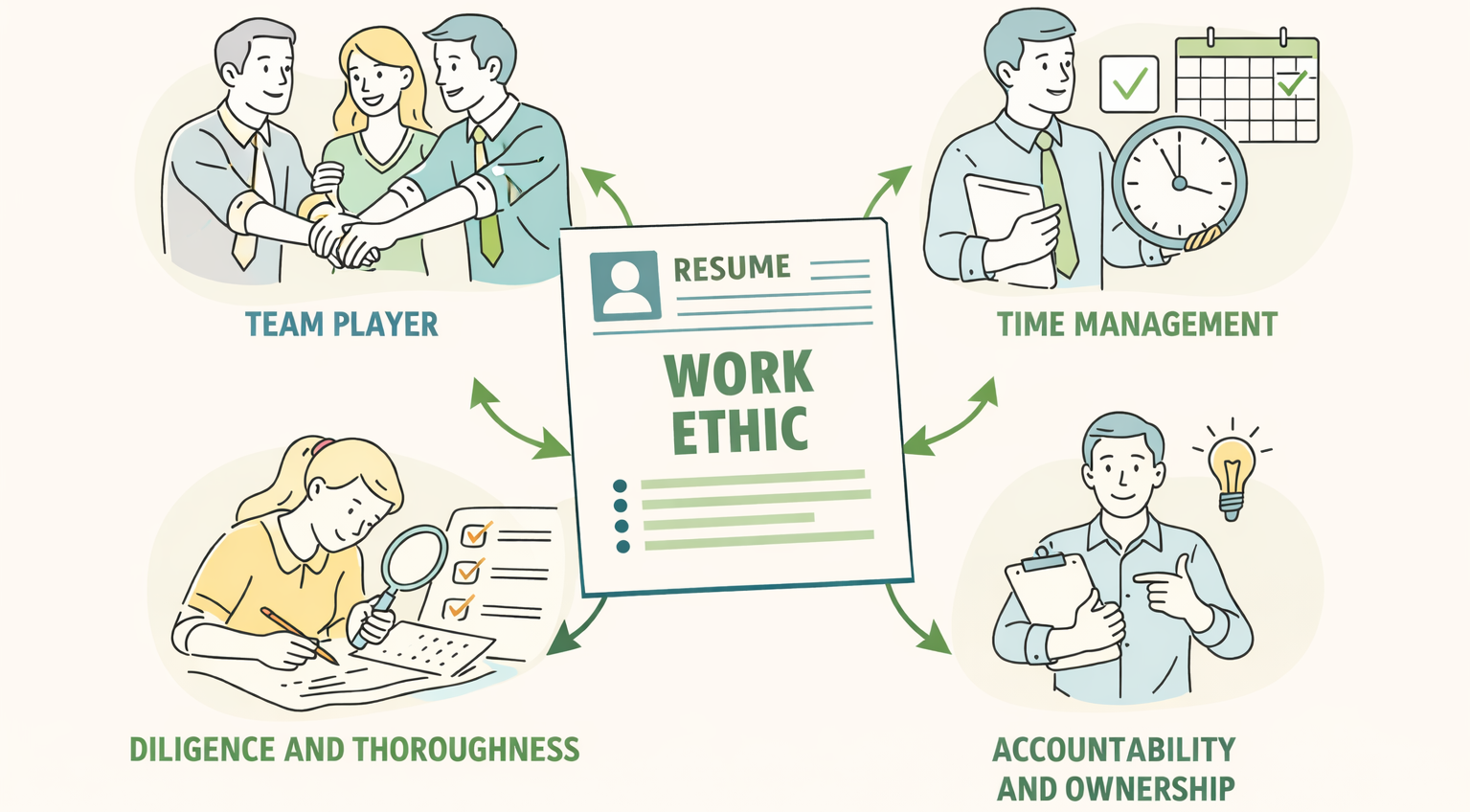
Before you can describe work ethic effectively, understand what employers mean when they list it in job descriptions. Work ethic encompasses several interconnected qualities:
| Component | What It Means | What Employers Look For |
|---|---|---|
| Reliability | Consistent performance and attendance | Meeting deadlines, maintaining quality standards |
| Initiative | Self-starting without constant supervision | Identifying problems, proposing solutions |
| Diligence | Attention to detail and thoroughness | Error-free work, comprehensive project completion |
| Professionalism | Appropriate workplace conduct | Positive team collaboration, communication skills |
| Adaptability | Flexibility when priorities shift | Managing multiple projects, handling change |
| Accountability | Ownership of outcomes | Taking responsibility, learning from mistakes |
When you describe work ethic on your resume, you’re actually describing how these components manifested in measurable results.
The Achievement-First Approach to Describing Work Ethic
The most effective way to demonstrate work ethic is through achievement-focused bullet points that follow this structure:
[Action Verb] + [What You Did] + [Quantifiable Result] + [Context That Shows Work Ethic]
Strong Work Ethic Examples:
❌ Instead of:
“Dedicated team member with strong work ethic”
✅ Write:
“Maintained 100% on-time project delivery rate across 23 client engagements over 18 months while managing 4 concurrent accounts”
Why it works: Shows reliability through specific metrics (100%, 23 engagements, 18 months) and demonstrates capacity to handle multiple priorities.
❌ Instead of:
“Hard worker who goes above and beyond”
✅ Write:
“Identified and resolved critical data integrity issue during weekend audit, preventing $340K in potential compliance penalties and earning departmental recognition”
Why it works: Demonstrates initiative (working weekend), attention to detail (found the issue), and accountability (quantified impact).
❌ Instead of:
“Self-motivated professional”
✅ Write:
“Proactively developed automated reporting system during off-hours, reducing weekly team reporting time from 12 hours to 45 minutes and improving data accuracy by 34%”
Why it works: Shows initiative (self-started project), diligence (worked beyond regular hours), and delivers measurable positive outcomes.
Learn how to list skills on your resume to balance technical abilities with traits that signal strong work ethic.
Action Verbs That Demonstrate Work Ethic
The verbs you choose signal different aspects of work ethic. Use these strategically based on what the job description emphasizes:
For Reliability & Consistency:
For Initiative & Proactivity:
For Diligence & Thoroughness:
For Adaptability & Problem-Solving:
For Accountability & Ownership:
Where to Showcase Work Ethic on Your Resume
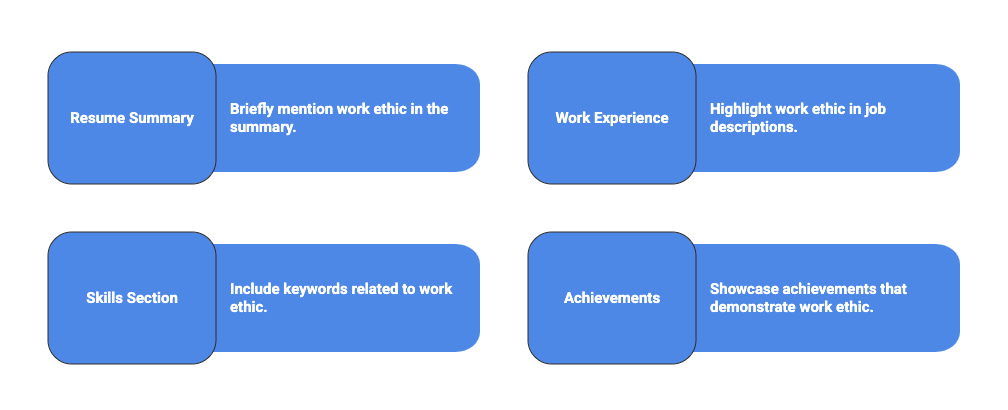
1. Resume Summary (Subtle Integration)
Your resume summary should hint at work ethic through achievements, not adjectives.
❌ Weak:
“Dedicated marketing professional with strong work ethic and proven track record”
✅ Strong:
“Marketing manager who consistently exceeded quarterly targets by 15-20% while managing cross-functional teams across 3 time zones and maintaining 98% client retention rate”
2. Work Experience Bullets (Primary Location)
The work experience section is the primary section for demonstrating your work ethic. Each bullet point should demonstrate reliability, initiative, or results-driven effort.
💡 Pro Tip: Use 3-5 bullets per role, with at least 2 demonstrating work ethic through outcomes. Refer to the example below.
Senior Operations Coordinator
TechCorp Solutions | 2025–Present
- Maintained 99.7% operational uptime across 12-month period by implementing proactive monitoring system and responding to 47 critical alerts within 15-minute SLA
- Reduced customer complaint resolution time by 41% (from 4.2 to 2.5 days) by redesigning intake process and personally handling escalated cases outside business hours
- Identified $180K in annual cost savings through vendor contract analysis conducted during Q4 planning cycle, leading to renegotiation of 8 service agreements
- Trained and onboarded 12 new team members while maintaining full workload, resulting in 30% faster time-to-productivity compared to previous cohorts
3. Skills Section (Strategic Keyword Placement)
While you shouldn’t list “work ethic” as a standalone skill, you can include related competencies that Applicant Tracking Systems recognize:
❌ Instead of:
✅ Use:
4. Achievements or Awards Section
If you have formal recognition, this directly validates your work ethic:
Tailoring Work Ethic Descriptions to Job Requirements
Different roles emphasize different aspects of work ethic. Match your descriptions to what the job description prioritizes.
For Customer-Facing Roles:
Focus on reliability, responsiveness, and customer satisfaction metrics.
Example:
“Maintained 4.9/5.0 customer satisfaction rating across 1,200+ support interactions by responding to all inquiries within 2-hour window and following up on 100% of unresolved cases”
For Technical Roles:
Emphasize attention to detail, problem-solving, and quality outcomes.
Example:
“Reduced production bug rate by 67% through implementation of comprehensive testing protocols and code review standards, conducting reviews outside sprint hours when needed”
For Leadership Roles:
Highlight accountability, team development, and sustained performance.
Example:
“Led department through organizational restructuring while maintaining team morale and productivity, resulting in zero voluntary departures and 12% performance improvement during transition period”
For Entry-Level or Career Change:
Draw from academic, volunteer, or transferable experience.
Example:
“Balanced full-time coursework with 25-hour weekly internship, maintaining 3.8 GPA while contributing to 3 published research projects and serving as peer mentor for 8 students”
Common Mistakes When Describing Work Ethic
❌ Using clichés without context:
“Results-driven professional with strong work ethic”
This tells recruiters nothing.
✅ Better approach:
Lead with specific results that imply work ethic:
“Delivered 18 consecutive projects on-time and under budget…”
❌ Listing work ethic as a skill:
“Skills: Microsoft Office, Work Ethic, Communication”
✅ Better approach:
Demonstrate it through achievement bullets and let the pattern speak for itself.
❌ Focusing on effort instead of outcomes:
“Worked long hours to complete projects”
✅ Better approach:
“Accelerated project timeline by 3 weeks through efficient resource allocation and proactive stakeholder communication, delivering ahead of client deadline”
❌ Being vague about what you accomplished:
“Consistently went above and beyond expectations”
✅ Better approach:
“Exceeded quarterly sales targets by average of 23% across 8 consecutive quarters while maintaining highest customer retention rate (94%) in region”
How Applicant Tracking Systems Evaluate Work Ethic
Applicant Tracking Systems don’t search for the phrase “work ethic” as they look for evidence of it through:
When you tailor your resume to a specific job description, pay attention to how the employer describes their ideal candidate’s work style. If they mention “self-starter,” emphasize initiative. If they want “reliable team player,” highlight consistency and team collaboration.
AI-powered resume optimization tools like Upplai can analyze job descriptions to identify which work ethic components matter most for a given role, then suggest achievement-focused bullets that demonstrate those qualities while maintaining ATS compatibility.
Quick Checklist: Does Your Resume Show Your Work Ethic?
Use this checklist to audit your current resume:
If you checked fewer than 7 boxes, your resume likely isn’t effectively demonstrating work ethic to recruiters or ATS systems.